Fingertip Injuries PDF Evidence
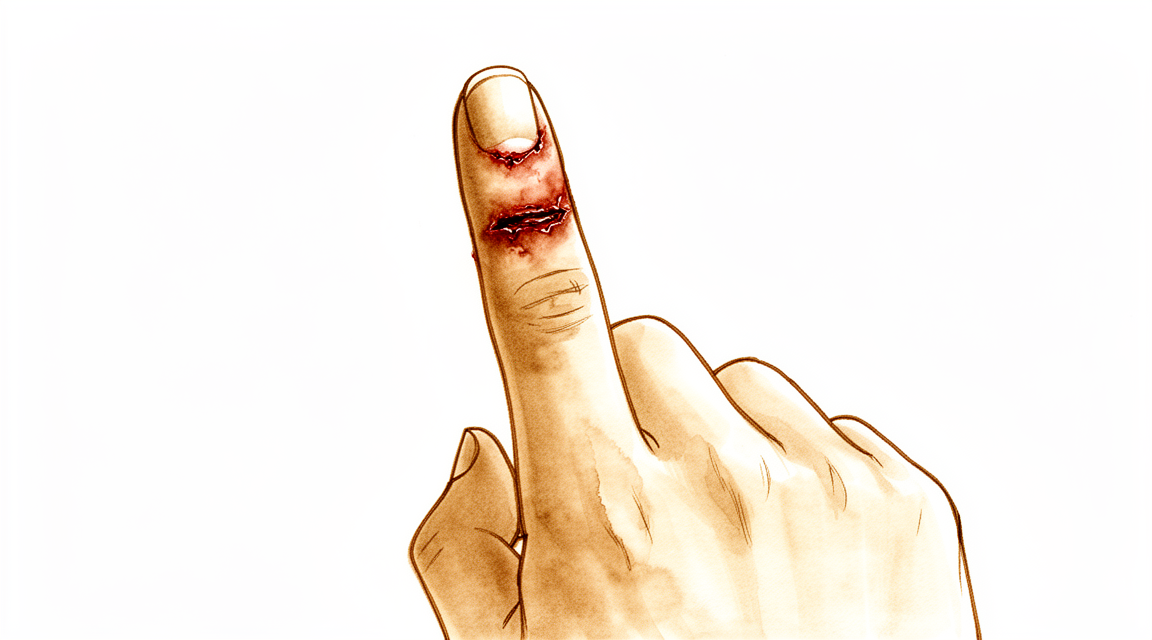
Crush, laceration, nail-bed and amputation injuries of the fingertip and their management.
What you're feeling
You may notice sharp pain right at the tip of your finger. This pain often comes from a cut, crush, or amputation that damaged the nail bed or the soft tissue underneath. The area might feel tender to the touch or sensitive to air. You might find it difficult to use your finger for daily tasks like typing, buttoning a shirt, or holding a cup. Simple movements can feel uncomfortable or painful.
If you have a nail bed injury, you might see bleeding under the nail or notice the nail is loose or missing. The skin around the tip may look red or swollen. In some cases, you might feel a throbbing sensation, especially if there is significant swelling. This discomfort can make it hard to sleep on your side if you rest your hand on that arm. You might also feel a strange sensitivity when your finger brushes against clothing or bedsheets.
Infection is a risk, but it is relatively uncommon. The chance of infection after a distal fingertip injury is low at 2.5%. You should watch for signs like increasing redness, warmth, pus, or fever. If these symptoms appear, contact your surgeon immediately. However, most patients do not develop an infection. Some studies question the need for preventive antibiotics because the infection rate is so low and similar between those who take them and those who do not.
Healing times vary depending on the treatment you receive. If you are treated with noncontact low-frequency ultrasound, your fingertip may heal nine times faster than with local wound care alone. If you undergo a revision amputation, you can expect to return to work on average approximately 7 weeks after the procedure. For other injuries, such as finger glomus tumours treated with a lateral-ungual approach, you might see significant pain improvement and normal function recovery in 3 weeks.
Your surgeon will choose the best option to restore the look and function of your fingertip. The goal is to minimize pain, preserve sensation, and keep your finger length. You might receive a flap graft or a composite graft to cover the exposed area. If you are a non-smoker and receive a composite graft within 5 hours of injury, you are more likely to have an excellent outcome. Your surgeon will guide you through the recovery process to ensure you get back to using your hand as normally as possible.
What's actually happening
Your fingertip is a complex mix of bone, skin, and delicate tissue designed for touch and grip. When you suffer an injury, you may lose part of the nail, the skin, or even the bone tip. The goal of treatment is to restore both function and appearance. You want to keep your sensation and be able to use your finger normally again.
There is no single standard way to fix every fingertip injury. Your surgeon will choose the best option for you based on the type of damage. Options range from simple wound care to complex surgery. The aim is to minimize pain, help healing, and preserve the length and feeling of your finger.
In some cases, conservative treatment works well. You might heal successfully without surgery, even if bone is exposed. For faster healing, noncontact low-frequency ultrasound can help. This treatment leads to healing nine times faster than local wound care alone.
If surgery is needed, your surgeon may use a flap. This involves moving healthy tissue from nearby to cover the wound. Some flaps preserve finger length and avoid immobilizing other fingers. Others provide durable coverage in one step. For nail damage, split-thickness nail bed grafts or direct flow island flaps can restore a satisfying look and function.
Infections are rare after these injuries, occurring in only 2.5% of cases. Because the risk is low, antibiotics are not always necessary. If you have significant bone loss, your surgeon might use a thenar flap from your palm. This adds length and support to prevent a shortened fingertip and avoids a hooked nail shape.
For older patients, primary flap reconstruction is often the best choice to maintain movement. In severe cases, revision amputation can still provide almost normal sensation and motion. On average, you can return to work about 7 weeks after this procedure. Your surgeon will balance immediate wound closure with long-term comfort, as flaps can sometimes cause stiffness or nerve pain compared to simple dressings.
What we can do about it
For many fingertip injuries, you can start with conservative care. This means letting the wound heal on its own without surgery. This approach works well even if bone is exposed. If you choose this path, your surgeon may recommend noncontact low-frequency ultrasound. This treatment uses sound waves to help the skin heal. Patients using this method healed nine times faster than those using local wound care alone. You can also use simple splints to protect the area. One common method uses a standard artificial nail as a splint for nail bed repairs. This helps keep the joint moving while it heals.
Your surgeon will focus on keeping you comfortable and preventing infection. The risk of infection after a fingertip amputation or crush injury is 2.5%. You might wonder if antibiotics are necessary. Research shows no meaningful difference in infection rates between patients who take prophylactic antibiotics and those who do not. Your surgeon will decide if you need them based on your specific injury. Pain management is also key. If you have a painful lump under the nail, known as a glomus tumour, your surgeon may recommend a specific approach to remove it. This method significantly reduces pain and restores normal function in 3 weeks. It also carries no risk of wound infection or nail deformity.
Surgery is considered when conservative care is not enough or when the injury is severe. Your surgeon aims to minimize pain, optimize healing, and preserve the length and sensation of your finger. There is no single standard way to treat these injuries. Options range from simple revisions to complex replantation. For example, if you have a partial loss of the fingertip involving the nail bed, your surgeon might use a split-thickness nail bed flap graft. This restores both appearance and function. If you have lost bone, a tripartite reconstruction using a thenar flap with bone and nail bed grafts can prevent a shortened finger and avoid deformity. In older patients, primary flap reconstruction is often the best choice to ensure you regain full movement. Your surgeon will choose the method that best fits your injury to give you the best possible outcome.
What to expect
Your fingertip injury will heal through a process that prioritizes both function and appearance. Your surgeon aims to restore the nail bed and soft tissue simultaneously. This approach helps prevent common issues like a shortened fingertip or a hooked nail shape. Most patients see a satisfying restoration of the fingertip’s look and feel.
Healing times vary based on the treatment chosen. If you receive noncontact low-frequency ultrasound, your wound may heal nine times faster than with local wound care alone. For those undergoing revision amputation, you can expect to return to work in approximately 7 weeks. This procedure often restores almost normal sensation and satisfactory motion.
Infection is a known risk, but it is uncommon. The incidence of infection after distal fingertip amputation or crush injury is 2.5%. There is no meaningful difference in infection rates between patients treated with and without prophylactic antibiotics. Because the risk is low, your surgeon may not prescribe preventive antibiotics.
If you choose conservative nonsurgical treatment, healing can still be successful without surgery, even if bone is exposed. Some patients use artificial nail splints to support repair. In one case, a patient recovered significant joint movement and had no recurrent infection after 18 months.
For cutting injuries, composite grafting offers excellent outcomes if performed within 5 hours of injury and if you do not smoke. Various flap techniques are available to cover defects. These methods preserve finger length and avoid immobilizing adjacent digits. Your surgeon will select the best option to minimize pain and optimize healing.
Overall, the outlook is positive. Whether treated surgically or conservatively, the goal is to return you to normal activities with minimal discomfort. You can expect your finger to regain strength and sensation over time. Regular follow-up ensures the nail grows back correctly and the fingertip remains stable.
When to see someone
See your GP if you have persistent pain that does not improve with rest. Ask for a specialist review if you notice weakness or instability in the finger. Seek care if the finger locks or gives way during use. Contact your doctor if symptoms interfere with your sleep or work. Go to urgent care for sudden worsening of the injury. While infection rates are low at 2.5%, watch for signs of infection. Some minor injuries heal without surgery, but noncontact low-frequency ultrasound can speed healing nine times faster than local care alone. If you have a cut, composite grafting works best if done within 5 hours.
Evidence & references
title: "Fingertip Injuries" slug: fingertip-injuries region: hand audience: patient mesh_terms: ["Finger Injuries", "Amputation, Traumatic", "Surgical Flaps", "Fingers", "Plastic Surgery Procedures", "Hand Injuries", "Replantation", "Nails"] article_count: 549 model_used: Qwen3.6-35B-A3B-Q8_0.gguf generated_at: '2026-06-16T19:34:33+00:00' key_articles: - title: "Fingertip Injuries in Children: Epidemiology, Financial Burden, and Implications for Prevention" ref_num: 1 evidence_tier: paper evidence_level: 4 doi: 10.1177/1558944716670139 year: 2016 - title: "COMPLICATIONS OF FINGERTIP INJURIES" ref_num: 2 evidence_tier: paper evidence_level: 5 doi: 10.1016/s0749-0712(21)01040-4 year: 1994 - title: "Antibiotic Prophylaxis in the Management of Distal Fingertip Amputation and Crush Injury" ref_num: 3 evidence_tier: paper evidence_level: 3 doi: 10.1016/j.jhsg.2023.07.010 year: 2023 - title: "Management of partial fingertip amputation in adults: Operative and non operative treatment" ref_num: 4 evidence_tier: paper doi: 10.1016/j.injury.2017.10.042 year: 2017 - title: "Parallelogram flap versus homodigital island flap in the treatment of fingertip defects with bone exposure: a prospective controlled study" ref_num: 5 evidence_tier: paper evidence_level: 2 doi: 10.1186/s13018-022-03214-1 year: 2022 - title: "Functional Reconstruction of Subtotal Thumb Metacarpal Defect With a Vascularized Medial Femoral Condyle Flap: Case Report" ref_num: 6 evidence_tier: case_report evidence_level: 4 doi: 10.1016/j.jhsa.2014.06.002 year: 2014 - title: "Digital avulsion injuries: epidemiology and factors influencing finger preservation" ref_num: 7 evidence_tier: paper evidence_level: 4 doi: 10.1007/s00402-020-03576-3 year: 2020 - title: "Fingertip repair methods: choices for different fingers and sides emphasizing sensation" ref_num: 8 evidence_tier: paper evidence_level: 5 doi: 10.1177/1753193419876496 year: 2019 - title: "Pediatric Fingertip Injuries: Association With Child Abuse" ref_num: 9 evidence_tier: paper evidence_level: 3 doi: 10.1016/j.jhsg.2019.09.001 year: 2020 - title: "Finger amputations and pulp defects distal to the distal interphalangeal joint" ref_num: 11 evidence_tier: paper evidence_level: 5 doi: 10.1177/1753193419873554 year: 2019 - title: "Comparative assessment of fingertip replantation in paediatric and adult patients within a single institution" ref_num: 13 evidence_tier: paper evidence_level: 4 doi: 10.1177/17531934211002476 year: 2021 - title: "Severe hand injuries resulting from Samurai sword assaults: a Dublin case series" ref_num: 14 evidence_tier: paper evidence_level: 4 doi: 10.1177/1753193410381576 year: 2010 - title: "The Biomechanical Impact of Digital Loss and Fusion Following Trauma" ref_num: 15 evidence_tier: paper evidence_level: 5 doi: 10.1016/j.hcl.2016.07.003 year: 2016 - title: "Patient-Reported Outcomes and Functional Assessment After Treatment of Open Fingertip Injuries" ref_num: 16 evidence_tier: paper evidence_level: 4 doi: 10.1177/175899830701200302 year: 2007 - title: "Retrospective Analysis of Functional Outcome of Distal Fingertip Replants Without Heparin" ref_num: 17 evidence_tier: paper evidence_level: 4 doi: 10.1016/j.jhsg.2024.02.018 year: 2025 - title: "Prevalence, characteristics and natural history of cold intolerance after the reverse digital artery flap" ref_num: 18 evidence_tier: paper evidence_level: 4 doi: 10.1177/1753193415596438 year: 2015 - title: "Fingertip Reconstruction" ref_num: 19 evidence_tier: paper evidence_level: 5 doi: 10.1016/j.jhsa.2008.07.001 year: 2008 - title: "Indications for Microsurgical Reconstruction of Congenital Hand Anomalies by Toe-To-Hand Transfers" ref_num: 21 evidence_tier: paper evidence_level: 4 doi: 10.1007/s11552-013-9534-5 year: 2013 - title: "Long-term clinical results of 33 thumb replantations" ref_num: 22 evidence_tier: paper evidence_level: 4 doi: 10.1016/j.injury.2020.11.006 year: 2020 - title: "Soft and tissue repair of the hand and digital reconstruction" ref_num: 23 evidence_tier: paper evidence_level: 5 doi: 10.1177/17531934211051303 year: 2021 - title: "Firework-Related Injuries of the Hand" ref_num: 24 evidence_tier: paper evidence_level: 4 doi: 10.1016/j.jhsa.2014.08.041 year: 2015 - title: "Biomechanics and hand trauma: what you need" ref_num: 26 evidence_tier: paper evidence_level: 5 doi: 10.1016/s0749-0712(02)00130-0 year: 2003 - title: "Extended Step-Advancement Flap for Avulsed Amputated Fingertip—A New Technique to Preserve Finger Length: Case Series" ref_num: 27 evidence_tier: paper evidence_level: 4 doi: 10.1016/j.jhsa.2010.10.008 year: 2011 - title: "The Restoration of Hand Function in Congenital Absence of Digits by Transplantation of a Toe - Surgical Aspects" ref_num: 28 evidence_tier: paper evidence_level: 4 doi: 10.1177/175899839900400302 year: 1999 - title: "Long-term outcomes after terminalization for acute fingertip injuries" ref_num: 32 evidence_tier: paper evidence_level: 4 doi: 10.1177/17531934241247276 year: 2024 - title: "Adverse Events Following Digital Replantation in the Elderly" ref_num: 34 evidence_tier: paper evidence_level: 3 doi: 10.1016/j.jhsa.2011.01.031 year: 2011 - title: "COVERAGE PROBLEMS IN THE TREATMENT OF WRINGER INJURIES" ref_num: 35 evidence_tier: paper evidence_level: 4 doi: 10.2106/00004623-195436020-00007 year: 1954 - title: "A New Classification for Fingertip Injuries" ref_num: 38 evidence_tier: paper evidence_level: 5 doi: 10.1054/jhsb.1999.0305 year: 2000 - title: "Ulnar artery distal cutaneous descending branch as free flap in hand reconstruction" ref_num: 40 evidence_tier: paper evidence_level: 4 doi: 10.1016/j.injury.2009.04.009 year: 2009 - title: "Split-Thickness Nail Bed Flap Graft in the Management of Distal Partial Defect of the Nail Bed Combined With Soft Tissue" ref_num: 41 evidence_tier: paper evidence_level: 4 doi: 10.1016/j.jhsa.2020.02.018 year: 2020 - title: "Aesthetic Reconstruction of Fingers and Thumbs With the Vascularized Half–Big Toenail Flap With Minimum Donor Site Morbidity" ref_num: 42 evidence_tier: paper evidence_level: 4 doi: 10.1016/j.jhsg.2020.05.005 year: 2020 - title: "Common Hand Problems with Different Treatments in Countries in Asia and Europe" ref_num: 43 evidence_tier: paper evidence_level: 5 doi: 10.1016/j.hcl.2017.04.010 year: 2017 - title: "Functional and subjective results of 20 thumb replantations" ref_num: 44 evidence_tier: paper evidence_level: 4 doi: 10.1016/j.injury.2012.11.009 year: 2013 - title: "Management of Thumb Tip Injuries" ref_num: 45 evidence_tier: paper evidence_level: 5 doi: 10.1016/j.jhsa.2014.09.028 year: 2015 - title: "Pollicization of the Second Metacarpal Based on Dorsal Metacarpal Arteries" ref_num: 46 evidence_tier: paper evidence_level: 4 doi: 10.1016/j.jhsa.2016.06.005 year: 2016 - title: "Predictors of Hand Function Following Digit Replantation: Quantitative Review and Meta-Analysis" ref_num: 47 evidence_tier: paper evidence_level: 1 doi: 10.1177/1558944719834658 year: 2019 - title: "Toe-to-hand transplantation" ref_num: 48 evidence_tier: paper evidence_level: 4 doi: 10.1016/s0749-0712(02)00127-0 year: 2003 - title: "Pushing the Boundaries of Salvage in Mutilating Upper Limb Injuries" ref_num: 51 evidence_tier: paper evidence_level: 4 doi: 10.1016/j.hcl.2016.06.003 year: 2016 - title: "Flexor-Tendon Grafts in the Less-Than-Optimum Situation" ref_num: 53 evidence_tier: paper evidence_level: 4 doi: 10.2106/00004623-196244070-00008 year: 1962 - title: "Fingertip and Thumb Tip Wounds: Changing Algorithms for Sensation, Aesthetics, and Function" ref_num: 54 evidence_tier: paper evidence_level: 5 doi: 10.1016/j.jhsa.2017.01.022 year: 2017 - title: "A new classification to aid the selection of revascularization techniques in major degloving injuries of the upper limb" ref_num: 56 evidence_tier: paper evidence_level: 4 doi: 10.1016/j.injury.2013.01.025 year: 2013 - title: "Immediate Versus Overnight-Delayed Digital Replantation: Comparative Retrospective Cohort Study of Survival Outcomes" ref_num: 57 evidence_tier: paper evidence_level: 4 doi: 10.1016/j.jhsa.2018.03.047 year: 2018 - title: "Relationship Between Sensory Recovery and Advancement Distance of Oblique Triangular Flap for Fingertip Reconstruction" ref_num: 58 evidence_tier: paper evidence_level: 3 doi: 10.1016/j.jhsa.2008.02.022 year: 2008 - title: "Secondary Thumb Reconstruction via Ectopic Banking of Bony Phalanges From a Nonreplantable Amputated Thumb: A Follow-Up Study" ref_num: 62 evidence_tier: paper evidence_level: 4 doi: 10.1016/j.jhsa.2022.06.027 year: 2024 synthesis_version: "v2" verifier_status: skipped
Overview
- Fingertip injuries in children are common and result in significant burden [1].
- Most fingertip injuries in children are preventable [1].
- Most fingertip injuries in children occur at home, often involving a door or window [1].
- Injuries to the fingertip must be treated with the same care as other hand surgery [2].
- Treatment of fingertip injuries should provide coverage to the tip of the finger with good quality skin [2].
- Treatment of fingertip injuries should aim for the best sensibility possible [2].
- The incidence of infection after distal fingertip amputation and crush injury is 2.5% [3].
- There is no meaningful difference in infection rates between groups with and without prophylactic antibiotics after distal fingertip injuries [3].
- The low incidence of infection and lack of difference between groups call into question prophylactic antibiotic prescribing after distal fingertip injuries [3].
- The parallelogram flap is a better choice for reconstruction of fingertip injury compared to the homodigital island flap in cases with bone exposure [5].
- Functional reconstruction of subtotal thumb metacarpal defect with a vascularized medial femoral condyle flap allows the patient to regain satisfactory grip and thumb function [6].
- Functional reconstruction of subtotal thumb metacarpal defect with a vascularized medial femoral condyle flap results in minimal donor site morbidity [6].
- Finger survival rate after ring avulsion injuries is mostly influenced by the extent of intrinsic damage [7].
- There is a lack of strong evidence, such as randomized controlled trials, to support clinical experience with very distal finger replantation [11].
- It is highly difficult to conduct well-designed prospective studies for very distal finger replantation [11].
- Paediatric fingertip replantation is recommended whenever possible because of the good outcomes achievable [13].
- Paediatric fingertip replantation is technically demanding [13].
- Minimal requirements for the hand are a stable wrist and 2 opposing sensate digits [15].
- Preservation of thumb-finger pinch and digito-palmar grip takes priority following digital loss and fusion [15].
- There is insufficient evidence to determine the best treatment method for composite defects of the fingertips [19].
- The lack of prospective randomized trials and disparate retrospective case series contributes to insufficient evidence for treating composite fingertip defects [19].
- Specific indications for toe-to-hand transfers in congenital hand anomalies are defined based on the presence or absence of the thumb and fingers [21].
- The extended step-advancement flap is a viable alternative to replantation of the avulsed amputated fingertip [27].
Anatomy & Pathophysiology
- Minimal requirements for hand function include a stable wrist and two opposing sensate digits [15].
- Preservation of thumb-finger pinch takes priority in functional hand requirements [15].
- Preservation of digito-palmar grip takes priority in functional hand requirements [15].
- The hand requires at least two sensate digits that can oppose with some power for functional prehension [26].
- Sensation constitutes 40% of the goal in thumb or fingertip repair [23].
- Length and appearance account for 50% of the goal in thumb or fingertip repair [23].
- A normal hand is not achievable through reconstruction, but improved function in sensibility, movement, communication, emotion, psychological, or aesthetic factors is achievable [28].
- Digit replantation does not restore premorbid hand function but results in adequate hand function [47].
- Basic function can almost always be restored in most severe upper limb injuries using current reconstructive techniques [51].
- Microsurgical toe-to-hand transplantation provides thumb and finger reconstruction superior to conventional techniques in appearance and function for the mutilated hand [48].
- The primary disadvantage of pollicization of the second metacarpal is narrowing of the palm width, which may result in reduced grip strength in manual laborers [46].
- Early placement of the hand in the position of function minimizes late complications such as restricted motion [35].
- The importance of a flexor-tendon graft in the severely injured hand is judged by its contribution to overall function rather than the exact degree of motion obtained [53].
Classification
- Fingertip injuries in children are common and result in a significant burden, yet are mostly preventable [1].
- Most fingertip injuries in children occur at home, specifically involving doors or windows [1].
- Patients presenting with abuse are significantly more likely to have fingertip injuries during childhood compared with those without recorded abuse [9].
- Fingertip injuries in childhood may be indicative of abuse or neglect [9].
- The severity of firework-related hand injuries can range from superficial burns to devastating loss of hand and digits [24].
- The PNB classification separates fingertip injuries into their effect on the pulp, nail, and bone [38].
- The PNB classification provides a three-digit number that accurately describes the injury for documentation, treatment instructions, and referral indications [38].
- The proposed classification for major degloving injuries of the upper limb clarifies decision-making for revascularization [56].
- AV shunting alone is indicated for palm-only injuries in the proposed degloving injury classification [56].
- Combined AV shunting and digital artery revascularization is required for injuries involving digits in the proposed degloving injury classification [56].
Clinical Presentation
- Fingertip injuries in children are common and result in a significant burden [1].
- Most fingertip injuries in children are preventable [1].
- Most fingertip injuries in children occur at home, specifically involving doors or windows [1].
- Patients presenting with abuse are significantly more likely to have fingertip injuries during childhood compared with those without recorded abuse [9].
- Fingertip injuries in childhood may be indicative of abuse or neglect [9].
- Severe hand injuries resulting from Samurai sword assaults can cause devastating loss of function [14].
- The severity of firework-related hand injuries can range from superficial burns to devastating loss of hand and digits [24].
- Patients continued to experience symptoms long-term after treatment of open fingertip injury, particularly cold intolerance or Trauma-Induced Cold Associated Symptoms (TICAS) [16].
- Long-term function was not significantly affected in some cases despite persistent symptoms [16].
- Significant differences in cold intolerance incidence were observed in age and specific digit involved, with a lower incidence in younger patients and the ring finger group [18].
Investigations
- Fingertip injuries in children are common and result in significant burden [1].
- Most fingertip injuries in children are preventable [1].
- Most fingertip injuries in children occur at home, often involving a door or window [1].
- Patients presenting with abuse are significantly more likely to have fingertip injuries during childhood compared with those without recorded abuse [9].
- Fingertip injuries in childhood may be indicative of abuse or neglect [9].
Treatment
- Fingertip injuries in children are mostly preventable, with most occurring at home in a door or window [1].
- Treatment of fingertip injuries requires providing coverage to the tip of the finger with good quality skin and the best sensibility possible [2].
- The low incidence of infection (2.5%) and lack of meaningful difference between groups question the utility of prophylactic antibiotic prescribing after distal fingertip amputation and crush injury [3].
- Management of partial fingertip amputation in adults depends on the degree of injury, employing various operative and non-operative techniques [4].
- The parallelogram flap is a better choice than the homodigital island flap for reconstruction of fingertip injuries with bone exposure [5].
- Functional reconstruction of subtotal thumb metacarpal defects with a vascularized medial femoral condyle flap allows patients to regain satisfactory grip and thumb function with minimal donor site morbidity [6].
- Finger survival rate after ring avulsion injuries is mostly influenced by the extent of intrinsic damage, despite microsurgical advances [7].
- There is a lack of strong evidence, such as randomized controlled trials, to support clinical experience with very distal finger replantation [11].
- Paediatric fingertip replantation is recommended whenever possible due to the good outcomes achievable, despite being technically demanding [13].
- Minimal requirements for hand function include a stable wrist and 2 opposing sensate digits, with preservation of thumb-finger pinch and digito-palmar grip taking priority [15].
- Distal fingertip replants without heparin show favorable functional outcomes [17].
- There is insufficient evidence to determine the best treatment method for composite defects of the fingertips due to the lack of prospective randomized trials and disparate retrospective case series [19].
- Specific indications for toe-to-hand transfers are defined based on the presence or absence of the thumb and fingers [21].
- The extended step-advancement flap is a viable alternative to replantation for preserving finger length in avulsed amputated fingertips [27].
- Age alone should not be an absolute contraindication to finger replantation [34].
- The ulnar artery distal cutaneous descending branch is an ideal free flap design for finger wound coverage due to its simple surgical method and high survival rate [40].
- Split-thickness nail bed flap grafts effectively achieve aesthetic and functional repair of distal partial digit defects combined with soft tissue loss [41].
- Treatment approaches for common hand problems vary significantly between Asian and European surgeons, with Europeans favoring conservative management and spontaneous regeneration for fingertip defects while Asians more frequently utilize flaps and replantation [43].
- Management of thumb tip injuries has evolved with an expanded armamentarium of versatile flaps and less donor site morbidity [45].
- Conservative treatment with semi-occlusive dressings has gained ground for thumb pulp injuries, yielding excellent results in contour and sensibility restoration [45].
- Conservative treatment with semiocclusive dressings has become more acceptable for fingertip and thumb tip injuries due to excellent results in restoring contour, sensibility, and aesthetics [54].
Complications
- Fingertip injuries in children are common and result in a significant burden [1].
- Most fingertip injuries in children are preventable [1].
- Most fingertip injuries in children occur at home, specifically involving doors or windows [1].
- Patients presenting with abuse are significantly more likely to have fingertip injuries during childhood compared with those without recorded abuse [9].
- Fingertip injuries in childhood may be indicative of abuse or neglect [9].
- The finger survival rate after ring avulsion injuries is mostly influenced by the extent of intrinsic damage, despite microsurgical advances and high levels of surgical expertise [7].
- Severe hand injuries resulting from Samurai sword assaults can cause devastating loss of function for victims [14].
- Poor results of treatment for fingertip injuries are directly related to the extensive nature of the injury to the fingers [20].
- The low incidence of infection (2.5%) and lack of a meaningful difference between groups call into question prophylactic antibiotic prescribing after distal fingertip amputation and crush injuries [3].
- Patients continued to experience symptoms long-term after treatment of open fingertip injury, particularly cold intolerance or Trauma-Induced Cold Associated Symptoms (TICAS) [16].
- Long-term function was not significantly affected in some cases despite persistent symptoms like cold intolerance after open fingertip injury treatment [16].
- Significant differences in cold intolerance incidence were observed in age and specific digit involved, with a lower incidence in younger patients and the ring finger group after reverse digital artery flap [18].
- Primary terminalization for acute fingertip injuries is associated with excellent long-term patient-reported outcomes [32].
- Primary terminalization for acute fingertip injuries is associated with high levels of satisfaction [32].
- Primary terminalization for acute fingertip injuries is associated with a low rate of complications [32].
- One in three patients report long-term neuropathic pain after primary terminalization for acute fingertip injuries [32].
- In cases where an oblique triangular flap was advanced more than 12 mm, sensory disturbance of the fingertip occurred and did not subside [58].
Recovery
- Fingertip injuries in children are common and result in a significant burden, yet are mostly preventable [1].
- Most fingertip injuries in children occur at home, often involving doors or windows [1].
- The incidence of infection after distal fingertip amputation and crush injury is low (2.5%) [3].
- There is no meaningful difference in infection rates between groups, questioning the utility of prophylactic antibiotic prescribing after distal fingertip injuries [3].
- Sensation recovery is of primary importance for fingertip injuries [8].
- There is a lack of strong evidence, such as randomized controlled trials, to support clinical experience with very distal finger replantation [11].
- It is highly difficult to conduct well-designed prospective studies for very distal finger replantation [11].
- Patients continue to experience symptoms long-term after treatment of open fingertip injuries, particularly cold intolerance or Trauma-Induced Cold Associated Symptoms (TICAS) [16].
- Long-term function is not significantly affected in some cases of open fingertip injury despite persistent symptoms [16].
- Distal fingertip replants performed without heparin show favorable functional outcomes [17].
- Poor results of treatment for finger injuries are directly related to the extensive nature of the injury [20].
- Thumb replantation interventions have positive long-term functional outcomes [22].
- Long-term results of thumb replantation confirm satisfactory outcomes in terms of general upper limb function, handgrip, and pinch strength [44].
- Long-term results of thumb replantation confirm satisfactory outcomes in terms of social and work reintegration [44].
- Delaying digital replantation overnight yields survival results comparable to immediate replantation in selected cases [57].
- Primary terminalization for acute fingertip injuries is associated with excellent long-term patient-reported outcomes [32].
- Primary terminalization for acute fingertip injuries is associated with high levels of satisfaction [32].
- Primary terminalization for acute fingertip injuries is associated with a low rate of complications [32].
- One in three patients report long-term neuropathic pain after primary terminalization for acute fingertip injuries [32].
- Aesthetic and functional outcomes of reconstructed thumbs and fingers using the vascularized half–big toenail flap significantly improve [42].
- Donor site functional morbidity is minimum when using the vascularized half–big toenail flap for aesthetic reconstruction [42].
- The duration of ectopic banking of bony phalanges before thumb reconstruction should be no more than 2 weeks [62].
Key Evidence
- [L4] Fingertip injuries in children are common and result in significant burden, yet are mostly preventable, with most injuries occurring at home in a door or window. (10.1177/1558944716670139)
- [L5] Injuries to the fingertip must be treated with the same care as is used for all other hand surgery, providing coverage to the tip of the finger with good quality of skin and with the best sensibility possible. (10.1016/s0749-0712(21)01040-4)
- [L3] The low incidence of infection (2.5%) and lack of a meaningful difference between groups call into question prophylactic antibiotic prescribing after these distal fingertip injuries. (10.1016/j.jhsg.2023.07.010)
- [Paper] However, the precise management of a fingertip injury in adults depends on the degree of injury itself, and a number of operative and non-operative techniques may be successfully employed. (10.1016/j.injury.2017.10.042)
- [L2] This method is a better choice for reconstruction of fingertip injury. (10.1186/s13018-022-03214-1)
- [Case_report] The patient regained satisfactory grip and thumb function with minimal donor site morbidity. (10.1016/j.jhsa.2014.06.002)
- [L4] Despite microsurgical advances and high levels of surgical expertise the finger survival rate after ring avulsion injuries still seems to be mostly influenced by the extent of intrinsic damage. (10.1007/s00402-020-03576-3)
- [L5] Sensation recovery is of primary importance for fingertip injuries. (10.1177/1753193419876496)
- [L3] Patients presenting with abuse are significantly more likely to have fingertip injuries during childhood compared with those without recorded abuse, which suggests that these injuries may be ones of abuse or neglect. (10.1016/j.jhsg.2019.09.001)
- [L5] The authors state there is a lack of strong evidence such as randomized controlled trials to support clinical experience with very distal finger replantation, though they believe it is highly difficult to conduct well-designed prospective studies for this procedure. (10.1177/1753193419873554)
- [L4] Although technically demanding, paediatric fingertip replantation is recommended, whenever possible, because of the good outcomes achievable. (10.1177/17531934211002476)
- [L4] This case series demonstrates the extent and severity of hand injuries that can be caused by sword assaults with devastating loss of function for the victims. (10.1177/1753193410381576)
- [L5] Minimal requirements for the hand are a stable wrist and 2 opposing sensate digits, with preservation of thumb-finger pinch and digito-palmar grip taking priority. (10.1016/j.hcl.2016.07.003)
- [L4] Patients continued to experience symptoms long-term after treatment of open fingertip injury, particularly 'cold intolerance' or 'Trauma-Induced Cold Associated Symptoms' (TICAS), although function was not significantly affected in some cases. (10.1177/175899830701200302)
- [L4] This study suggests favorable functional outcomes for distal fingertip replants without heparin. (10.1016/j.jhsg.2024.02.018)
- [L4] Significant differences were observed in age and specific digit involved, with a lower incidence in younger patients and the ring finger group. (10.1177/1753193415596438)
- [L5] There is insufficient evidence to determine the best treatment method for composite defects of the fingertips due to the lack of prospective randomized trials and disparate retrospective case series. (10.1016/j.jhsa.2008.07.001)
- [L4] The study defines specific indications for toe transfers based on the presence or absence of the thumb and fingers. (10.1007/s11552-013-9534-5)
- [L4] Results confirm and strengthen evidence of positive long-term functional outcomes of thumb replantation interventions. (10.1016/j.injury.2020.11.006)
- [L5] Sensation is the most important factor in thumb or fingertip repair, constituting 40% of the goal, while length and appearance account for 50%. (10.1177/17531934211051303)
- [L4] The severity of firework-related injury can range from superficial burns to devastating loss of hand and digits. (10.1016/j.jhsa.2014.08.041)
- [L5] The hand requires a stable wrist and at least two sensate digits that can oppose with some power for functional prehension. (10.1016/s0749-0712(02)00130-0)
- [L4] It is a viable alternative to replantation of the fingertip. (10.1016/j.jhsa.2010.10.008)
- [L4] A normal hand is not achievable but a hand with improved function in terms of sensibility, movement, communication, emotion, psychological or aesthetic factors is achievable. (10.1177/175899839900400302)
- [L4] Primary terminalization for acute fingertip injuries is associated with excellent long-term patient-reported outcomes, high levels of satisfaction, and a low rate of complications, despite one in three patients reporting long-term neuropathic pain. (10.1177/17531934241247276)
- [L3] Age alone should not be an absolute contraindication to finger replantation. (10.1016/j.jhsa.2011.01.031)
- [L4] Early placement of the hand in the position of function minimizes late complications such as restricted motion. (10.2106/00004623-195436020-00007)
- [L5] The PNB classification separates fingertip injuries into their effect on the pulp, nail, and bone, providing a three-digit number that accurately describes the injury for documentation, treatment instructions, and referral indications. (10.1054/jhsb.1999.0305)
- [L4] The simple surgical method and high survival rate make this flap design ideal for finger wound coverage. (10.1016/j.injury.2009.04.009)
- [L4] The outcomes showed that this technique effectively achieves aesthetic and functional repair of a distal partial digit defect. (10.1016/j.jhsa.2020.02.018)
- [L4] The aesthetic and functional outcomes of the reconstructed thumbs and fingers significantly improved, and donor site functional morbidity was minimum. (10.1016/j.jhsg.2020.05.005)
- [L5] Treatment approaches for common hand problems vary significantly between Asian and European surgeons, with Europeans favoring conservative management and spontaneous regeneration for fingertip defects while Asians more frequently utilize flaps and replantation. (10.1016/j.hcl.2017.04.010)
- [L4] The long-term results of thumb replantation confirm satisfactory outcomes in terms of general upper limb function, handgrip and pinch strength, and social and work reintegration. (10.1016/j.injury.2012.11.009)
- [L5] The management of thumb tip injuries has evolved with an expanded armamentarium of versatile flaps and less donor site morbidity, while conservative treatment with semi-occlusive dressings has gained ground for pulp injuries, yielding excellent results in contour and sensibility restoration. (10.1016/j.jhsa.2014.09.028)
- [L4] The primary disadvantage is narrowing of the palm width, which may result in reduced grip strength in manual laborers. (10.1016/j.jhsa.2016.06.005)
- [L1] Digit replant does not restore premorbid hand function but does result in adequate hand function. (10.1177/1558944719834658)
- [L4] In the mutilated hand microsurgical toe-to-hand transplantation provides thumb and finger reconstruction that is superior to conventional techniques in appearance and function. (10.1016/s0749-0712(02)00127-0)
- [L4] Even in most severe injuries of the upper limb, basic function can almost always be restored using the current available reconstructive armamentarium. (10.1016/j.hcl.2016.06.003)
- [L4] The importance of a flexor-tendon graft in the severely injured hand is judged by the contribution to the over-all function rather than the exact degree of motion obtained. (10.2106/00004623-196244070-00008)
- [L5] The article provides an update on the most commonly used flaps and semiocclusive dressing treatments for fingertip and thumb tip injuries, noting that conservative treatment with semiocclusive dressings has become more acceptable due to excellent results in restoring contour, sensibility, and aesthetics. (10.1016/j.jhsa.2017.01.022)
- [L4] The proposed classification clarifies decision-making for revascularization: AV shunting alone is indicated for palm-only injuries, while combined AV shunting and digital artery revascularization is required for injuries involving digits. (10.1016/j.injury.2013.01.025)
- [L4] The results of delaying replantation of digits overnight give results comparable with those of immediate replantation in selected cases. (10.1016/j.jhsa.2018.03.047)
- [L3] In cases where the flap was advanced more than 12 mm, sensory disturbance of the fingertip occurred and did not subside. (10.1016/j.jhsa.2008.02.022)
- [L4] The duration of banking before thumb reconstruction should be no more than 2 weeks. (10.1016/j.jhsa.2022.06.027)
References
[1] Fingertip Injuries in Children: Epidemiology, Financial Burden, and Implications for Prevention. HAND. 2016. DOI: 10.1177/1558944716670139 [2] COMPLICATIONS OF FINGERTIP INJURIES. Hand Clinics. 1994. DOI: 10.1016/s0749-0712(21)01040-4 [3] Antibiotic Prophylaxis in the Management of Distal Fingertip Amputation and Crush Injury. Journal of Hand Surgery Global Online. 2023. DOI: 10.1016/j.jhsg.2023.07.010 [4] Management of partial fingertip amputation in adults: Operative and non operative treatment. Injury. 2017. DOI: 10.1016/j.injury.2017.10.042 [5] Parallelogram flap versus homodigital island flap in the treatment of fingertip defects with bone exposure: a prospective controlled study. Journal of Orthopaedic Surgery and Research. 2022. DOI: 10.1186/s13018-022-03214-1 [6] Functional Reconstruction of Subtotal Thumb Metacarpal Defect With a Vascularized Medial Femoral Condyle Flap: Case Report. The Journal of Hand Surgery. 2014. DOI: 10.1016/j.jhsa.2014.06.002 [7] Digital avulsion injuries: epidemiology and factors influencing finger preservation. Archives of Orthopaedic and Trauma Surgery. 2020. DOI: 10.1007/s00402-020-03576-3 [8] Fingertip repair methods: choices for different fingers and sides emphasizing sensation. Journal of Hand Surgery (European Volume). 2019. DOI: 10.1177/1753193419876496 [9] Pediatric Fingertip Injuries: Association With Child Abuse. Journal of Hand Surgery Global Online. 2020. DOI: 10.1016/j.jhsg.2019.09.001 [11] Finger amputations and pulp defects distal to the distal interphalangeal joint. Journal of Hand Surgery (European Volume). 2019. DOI: 10.1177/1753193419873554 [13] Comparative assessment of fingertip replantation in paediatric and adult patients within a single institution. Journal of Hand Surgery (European Volume). 2021. DOI: 10.1177/17531934211002476 [14] Severe hand injuries resulting from Samurai sword assaults: a Dublin case series. Journal of Hand Surgery (European Volume). 2010. DOI: 10.1177/1753193410381576 [15] The Biomechanical Impact of Digital Loss and Fusion Following Trauma. Hand Clinics. 2016. DOI: 10.1016/j.hcl.2016.07.003 [16] Patient-Reported Outcomes and Functional Assessment After Treatment of Open Fingertip Injuries. The British Journal of Hand Therapy. 2007. DOI: 10.1177/175899830701200302 [17] Retrospective Analysis of Functional Outcome of Distal Fingertip Replants Without Heparin. Journal of Hand Surgery Global Online. 2025. DOI: 10.1016/j.jhsg.2024.02.018 [18] Prevalence, characteristics and natural history of cold intolerance after the reverse digital artery flap. Journal of Hand Surgery (European Volume). 2015. DOI: 10.1177/1753193415596438 [19] Fingertip Reconstruction. The Journal of Hand Surgery. 2008. DOI: 10.1016/j.jhsa.2008.07.001 [20] 10.1016-0020-1383-90-90068-6. n.d.. [21] Indications for Microsurgical Reconstruction of Congenital Hand Anomalies by Toe-To-Hand Transfers. HAND. 2013. DOI: 10.1007/s11552-013-9534-5 [22] Long-term clinical results of 33 thumb replantations. Injury. 2020. DOI: 10.1016/j.injury.2020.11.006 [23] Soft and tissue repair of the hand and digital reconstruction. Journal of Hand Surgery (European Volume). 2021. DOI: 10.1177/17531934211051303 [24] Firework-Related Injuries of the Hand. The Journal of Hand Surgery. 2015. DOI: 10.1016/j.jhsa.2014.08.041 [26] Biomechanics and hand trauma: what you need. Hand Clinics. 2003. DOI: 10.1016/s0749-0712(02)00130-0 [27] Extended Step-Advancement Flap for Avulsed Amputated Fingertip—A New Technique to Preserve Finger Length: Case Series. The Journal of Hand Surgery. 2011. DOI: 10.1016/j.jhsa.2010.10.008 [28] The Restoration of Hand Function in Congenital Absence of Digits by Transplantation of a Toe - Surgical Aspects. The British Journal of Hand Therapy. 1999. DOI: 10.1177/175899839900400302 [32] Long-term outcomes after terminalization for acute fingertip injuries. Journal of Hand Surgery (European Volume). 2024. DOI: 10.1177/17531934241247276 [34] Adverse Events Following Digital Replantation in the Elderly. The Journal of Hand Surgery. 2011. DOI: 10.1016/j.jhsa.2011.01.031 [35] COVERAGE PROBLEMS IN THE TREATMENT OF WRINGER INJURIES. The Journal of Bone & Joint Surgery. 1954. DOI: 10.2106/00004623-195436020-00007 [38] A New Classification for Fingertip Injuries. Journal of Hand Surgery. 2000. DOI: 10.1054/jhsb.1999.0305 [40] Ulnar artery distal cutaneous descending branch as free flap in hand reconstruction. Injury. 2009. DOI: 10.1016/j.injury.2009.04.009 [41] Split-Thickness Nail Bed Flap Graft in the Management of Distal Partial Defect of the Nail Bed Combined With Soft Tissue. The Journal of Hand Surgery. 2020. DOI: 10.1016/j.jhsa.2020.02.018 [42] Aesthetic Reconstruction of Fingers and Thumbs With the Vascularized Half–Big Toenail Flap With Minimum Donor Site Morbidity. Journal of Hand Surgery Global Online. 2020. DOI: 10.1016/j.jhsg.2020.05.005 [43] Common Hand Problems with Different Treatments in Countries in Asia and Europe. Hand Clinics. 2017. DOI: 10.1016/j.hcl.2017.04.010 [44] Functional and subjective results of 20 thumb replantations. Injury. 2013. DOI: 10.1016/j.injury.2012.11.009 [45] Management of Thumb Tip Injuries. The Journal of Hand Surgery. 2015. DOI: 10.1016/j.jhsa.2014.09.028 [46] Pollicization of the Second Metacarpal Based on Dorsal Metacarpal Arteries. The Journal of Hand Surgery. 2016. DOI: 10.1016/j.jhsa.2016.06.005 [47] Predictors of Hand Function Following Digit Replantation: Quantitative Review and Meta-Analysis. HAND. 2019. DOI: 10.1177/1558944719834658 [48] Toe-to-hand transplantation. Hand Clinics. 2003. DOI: 10.1016/s0749-0712(02)00127-0 [51] Pushing the Boundaries of Salvage in Mutilating Upper Limb Injuries. Hand Clinics. 2016. DOI: 10.1016/j.hcl.2016.06.003 [53] Flexor-Tendon Grafts in the Less-Than-Optimum Situation. The Journal of Bone & Joint Surgery. 1962. DOI: 10.2106/00004623-196244070-00008 [54] Fingertip and Thumb Tip Wounds: Changing Algorithms for Sensation, Aesthetics, and Function. The Journal of Hand Surgery. 2017. DOI: 10.1016/j.jhsa.2017.01.022 [56] A new classification to aid the selection of revascularization techniques in major degloving injuries of the upper limb. Injury. 2013. DOI: 10.1016/j.injury.2013.01.025 [57] Immediate Versus Overnight-Delayed Digital Replantation: Comparative Retrospective Cohort Study of Survival Outcomes. The Journal of Hand Surgery. 2018. DOI: 10.1016/j.jhsa.2018.03.047 [58] Relationship Between Sensory Recovery and Advancement Distance of Oblique Triangular Flap for Fingertip Reconstruction. The Journal of Hand Surgery. 2008. DOI: 10.1016/j.jhsa.2008.02.022 [62] Secondary Thumb Reconstruction via Ectopic Banking of Bony Phalanges From a Nonreplantable Amputated Thumb: A Follow-Up Study. The Journal of Hand Surgery. 2024. DOI: 10.1016/j.jhsa.2022.06.027