Flexor Tendon Sheath Ganglion PDF Evidence
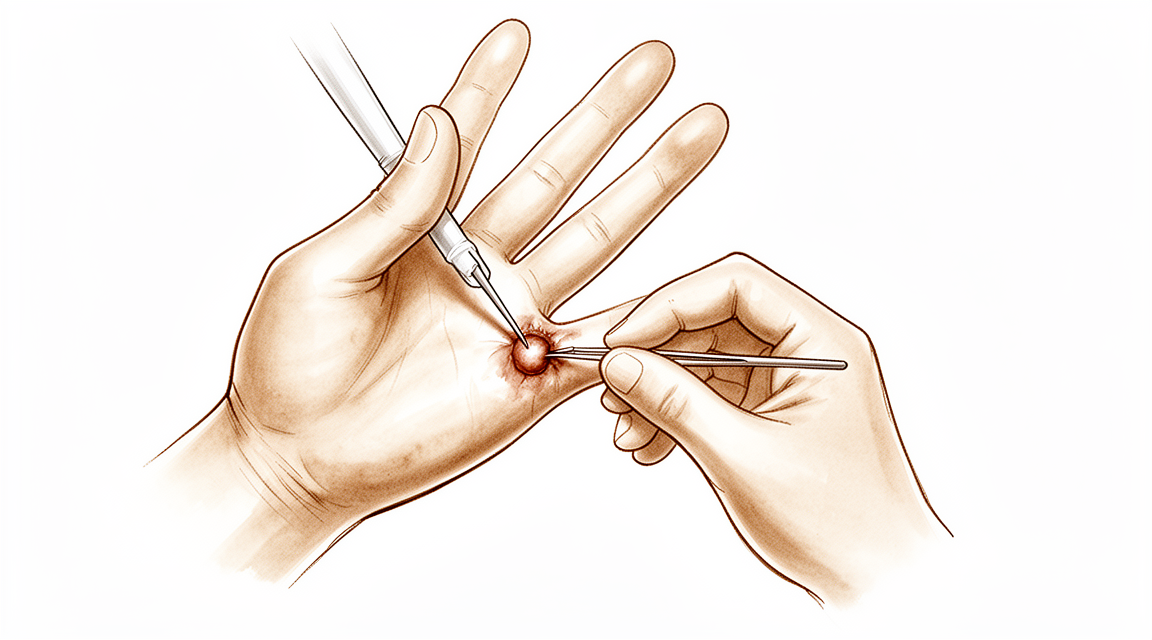
A benign, fluid-filled cyst arising from the flexor tendon sheath – often painless, but can cause clicking or limited finger movement.
What you're feeling
You may notice a lump or swelling on the palm side of your wrist or hand. This is a ganglion cyst, which is a common, non-cancerous fluid-filled sac. It sits near the tendons that bend your fingers. You might feel a dull ache in this area. The pain often comes and goes. It tends to flare up after you use your hand for a long time. You may also feel discomfort when you first wake up in the morning.
As the condition progresses, you might experience triggering. This happens when the tendon thickens and catches as it moves through its sheath. Your finger may lock in a bent position. You might have to use your other hand to straighten it. This catching sensation can be startling and uncomfortable. In some cases, the cyst itself presses on the tendon at the wrist, causing similar locking issues there.
Daily tasks can become difficult. Simple movements like reaching behind your back to fasten a bra may hurt. Tucking in a shirt or gripping a steering wheel can feel stiff and painful. You might avoid lifting heavy objects because it aggravates the area. Sleeping on the side of your affected hand can be particularly uncomfortable due to the pressure on the lump.
It is important to know that these symptoms are manageable. Your surgeon can help you understand exactly what is happening inside your hand. While the thickening of the tendon often happens before you feel triggering, the pain and stiffness are real and valid. You are not imagining the difficulty with these everyday motions. Treatment options, such as surgical removal of the cyst, are simple and effective. This approach aims to relieve your pain and restore smooth movement to your tendons.
What's actually happening
A ganglion is a fluid-filled lump that forms near your tendons. In this case, it sits inside the sheath that covers the flexor tendon. This sheath is the slippery tunnel that allows your tendon to slide smoothly as you bend your fingers. Think of the tendon like a rope and the sheath like the sleeve around it. The ganglion is a small balloon of fluid that bulges into this sleeve.
This lump can cause pain and make it difficult to move your finger. It may feel like the finger is catching or locking. Your surgeon can remove this ganglion safely. Surgical excision is a simple, safe, and effective method for treating a painful ganglion of the digital flexor tendon sheath. The goal is to relieve your pain and restore normal movement.
When treating a ganglion that grows inside the tendon itself, your surgeon takes extra care. The ganglion can weaken the tendon fibers. Therefore, treatment must include preserving the tendon. Your surgeon will remove the cyst while keeping the tendon strong and intact. This approach ensures you can continue to use your hand without long-term weakness.
Understanding how these structures work helps explain your symptoms. The tendon and its surrounding tissues are designed for smooth, repetitive motion. When a ganglion is present, it disrupts this flow. It creates friction and pressure within the tight space of the finger or thumb. This is why you feel discomfort or stiffness. By addressing the source of the irritation, your surgeon helps your hand return to its natural function.
What we can do about it
You can start with self-management and physiotherapy. Your surgeon may suggest splinting to rest the hand and wrist. This helps reduce irritation in the tendon sheath. Physical therapy aims to keep the joint moving smoothly. You might also try gentle exercises to improve strength. These non-surgical steps are often enough to manage symptoms. Give this approach a fair trial before considering more invasive options.
If rest and therapy do not bring enough relief, your surgeon may discuss medical management. Pain medication and anti-inflammatories can help control discomfort. Injections are another common option. Cortisone injections reduce swelling and calm inflammation in the sheath. Hyaluronic acid injections may help lubricate the joint space. Platelet-rich plasma (PRP) injections use your own blood components to support healing. These treatments target the pain and stiffness directly. The effect of these injections can vary, but they often provide significant relief for several months. Your surgeon will choose the best injection type for your specific case. For trigger finger caused by a volar wrist ganglion, interventional radiological measures might be an option instead of open surgery. This minimally invasive needle-knife technique has shown a 99% satisfactory result rate with no injuries to flexor tendons, arteries, or nerves. When injections are needed, the mid-axial injection technique is the most accurate way to deliver medicine into the sheath without risking damage to the tendon itself.
Surgery is considered only when conservative care has reached its limit. This means you have tried rest, therapy, and injections without lasting improvement. Your surgeon will discuss surgical excision if the ganglion remains painful or limits your movement. This is a simple, safe, and effective method for treating a painful ganglion of the digital flexor tendon sheath. The goal is to remove the cyst while preserving the tendon. Since ganglions can weaken the tendon, your surgeon will take care to protect it during the procedure. The operation itself is detailed on its own page, but the main aim is to relieve your pain and restore normal function.
What to expect
A ganglion cyst in your finger’s flexor tendon sheath is a common, benign lump. It is not cancer and will not spread. You may notice the lump appearing and disappearing over time. Some people find it painless, while others experience discomfort or stiffness.
If you choose to leave it alone, the cyst may stay the same size, shrink, or go away on its own. However, it can also grow larger or become more painful. If the cyst presses on the tendon, it might cause triggering, where your finger catches or locks when you bend it. This thickening of the tendon often happens before you feel any locking sensation, except in the thumb.
Surgical removal is a simple, safe, and effective way to treat a painful ganglion. Your surgeon will remove the cyst while carefully preserving the tendon. The tendon may be weakened by the cyst, so protecting it is a key part of the procedure. Many patients find that removing the cyst relieves pain and improves hand function.
Recovery involves healing the skin and allowing the tendon to move freely again. You might experience some stiffness in your finger after the procedure. This is normal. Even with careful treatment, some residual stiffness can remain for a while as the tissues settle. Your surgeon will guide you on gentle movements to keep the finger flexible without straining the repair.
Most people return to their normal daily activities as the swelling goes down and strength returns. The goal is to have a pain-free finger that moves smoothly. While outcomes are generally good, individual results can vary based on how your body heals. Your surgeon will discuss what is realistic for your specific situation during your consultation.
When to see someone
Ask for a specialist review if you notice a mass in your hand or wrist. Ganglion cysts are common benign lesions that may present as these masses. Seek care if you experience triggering pathology at the wrist, as a volar wrist ganglion can present this way. See your GP if you have persistent pain not improving with rest. Ask for a specialist review if you feel weakness or instability. See your doctor if your finger locks or gives way. Seek help if symptoms interfere with sleep or work. Sudden worsening of these signs also warrants prompt evaluation. Clinical examination is a valuable tool for detecting flexor disease, so professional assessment is key to getting the right diagnosis and treatment.
Evidence & references
title: "Flexor Tendon Sheath Ganglion" slug: flexor-tendon-sheath-ganglion region: hand audience: patient mesh_terms: ["Fingers", "Tendons", "Ganglion Cysts", "Wrist", "Trigger Finger Disorder", "Tenosynovitis", "Finger Joint", "Finger Injuries"] article_count: 84 model_used: Qwen3.6-35B-A3B-Q8_0.gguf generated_at: '2026-06-13T10:21:10+00:00' key_articles: - title: "Sonographic Appearance of the Flexor Tendon, Volar Plate, and A1 Pulley With Respect to the Severity of Trigger Finger" ref_num: 1 evidence_tier: paper evidence_level: 4 doi: 10.1016/j.jhsa.2012.06.027 year: 2012 - title: "Flexor Tendon Sheath Ganglions: Results of Surgical Excision" ref_num: 2 evidence_tier: paper evidence_level: 4 doi: 10.1007/s11552-007-9028-4 year: 2007 - title: "Tenosynovitis of the extensor pollicis longus tendon caused by an intratendinous ganglion: a case report" ref_num: 3 evidence_tier: case_report evidence_level: 5 doi: 10.1177/1753193412453428 year: 2012 - title: "Outcomes of Wide-Awake Flexor Tendon Repairs in 58 Fingers and 9 Thumbs" ref_num: 4 evidence_tier: paper evidence_level: 4 doi: 10.1016/j.jhsa.2022.01.015 year: 2023 - title: "Flexor digitorum profundus with or without flexor digitorum superficialis tendon repair in acute Zone 2B injuries" ref_num: 5 evidence_tier: paper evidence_level: 3 doi: 10.1177/1753193420932446 year: 2020 - title: "Adhesions as a component of the trigger finger: a dynamic sonographic study" ref_num: 6 evidence_tier: paper evidence_level: 2 doi: 10.1177/1753193420969293 year: 2020 - title: "Flexor Tendon Sheath Infections of the Hand" ref_num: 7 evidence_tier: paper evidence_level: 5 doi: 10.5435/jaaos-20-06-373 year: 2012 - title: "Finger flexor tendon injuries repaired surgically followed by an early active motion program: A prospective cohort study of clinician- and patient-reported outcomes" ref_num: 8 evidence_tier: paper evidence_level: 3 doi: 10.1016/j.jht.2024.12.011 year: 2026 - title: "Tendinopathies of the Hand and Wrist" ref_num: 9 evidence_tier: paper evidence_level: 5 doi: 10.5435/jaaos-d-14-00216 year: 2015 - title: "Volar wrist ganglion presenting as trigger finger" ref_num: 10 evidence_tier: paper evidence_level: 4 doi: 10.1177/1753193412453699 year: 2012 - title: "Ganglion cysts and other tumor related conditions of the hand and wrist" ref_num: 11 evidence_tier: paper evidence_level: 5 doi: 10.1016/j.hcl.2004.03.015 year: 2004 - title: "Six-Strand Flexor Pollicis Longus Tendon Repairs With and Without Circumferential Sutures: A Multicenter Study" ref_num: 12 evidence_tier: paper evidence_level: 3 doi: 10.1177/15589447211057295 year: 2022 - title: "Accuracy and Safety of Non-Image Guided Trigger Finger Injections: A Cadaveric Study" ref_num: 13 evidence_tier: paper evidence_level: 5 doi: 10.1177/15589447221093676 year: 2022 - title: "A technique for accurately marking the A1 pulley on the skin" ref_num: 15 evidence_tier: paper evidence_level: 4 doi: 10.1177/1753193411436294 year: 2012 - title: "Wide-awake Flexor Tendon Repair and Early Tendon Mobilization in Zones 1 and 2" ref_num: 17 evidence_tier: paper evidence_level: 5 doi: 10.1016/j.hcl.2013.02.009 year: 2013 - title: "Differential Pulley Release in Trigger Finger: A Prospective, Randomized Clinical Trial" ref_num: 18 evidence_tier: paper evidence_level: 1 doi: 10.1177/1558944721994231 year: 2021 - title: "Biomechanics and hand trauma: what you need" ref_num: 20 evidence_tier: paper evidence_level: 5 doi: 10.1016/s0749-0712(02)00130-0 year: 2003 - title: "Absent Ring Finger Flexor Digitorum Profundus Presenting as a Jersey Finger" ref_num: 23 evidence_tier: paper evidence_level: 4 doi: 10.1016/j.jhsa.2016.02.003 year: 2016 - title: "Congenital Hypoplasia of the Extensor Tendons of the Fingers: A Case Report and Review of the Literature" ref_num: 25 evidence_tier: case_report evidence_level: 4 doi: 10.1016/j.jhsa.2019.03.018 year: 2020 - title: "An in-depth look at zone III and IV anatomy of the finger extensor mechanism and some clinical implications for use of the relative motion flexion orthosis" ref_num: 26 evidence_tier: paper evidence_level: 5 doi: 10.1016/j.jht.2023.01.002 year: 2023 - title: "The balanced finger: biomechanics of intrinsic and extrinsic systems and principles of reconstruction" ref_num: 27 evidence_tier: paper evidence_level: 5 doi: 10.1177/17531934261427638 year: 2026 - title: "Hand Surface Landmarks and Measurements in the Treatment of Trigger Thumb" ref_num: 28 evidence_tier: paper evidence_level: 5 doi: 10.1016/j.jhsa.2013.02.028 year: 2013 - title: "A commentary from the pioneers on the innovation of the relative motion concept: History, biologic considerations, and anatomic rationale" ref_num: 29 evidence_tier: paper evidence_level: 5 doi: 10.1016/j.jht.2022.12.006 year: 2023 - title: "Shear Strain and Motion of the Subsynovial Connective Tissue and Median Nerve During Single-Digit Motion" ref_num: 32 evidence_tier: paper evidence_level: 5 doi: 10.1016/j.jhsa.2008.09.021 year: 2009 - title: "Ultrasonographic assessment in vivo of the excursion and tension of flexor digitorum profundus tendon on different rehabilitation protocols after tendon repair" ref_num: 33 evidence_tier: paper evidence_level: 4 doi: 10.1016/j.jht.2021.01.006 year: 2022 - title: "Longitudinal Tear of the Central Slip Causing Painful and Unusual Snapping of the Finger: A Case Report" ref_num: 35 evidence_tier: case_report evidence_level: 4 doi: 10.1177/15589447221081876 year: 2022 - title: "Defining the Digit-Specific Confluence of the A1 Pulley" ref_num: 36 evidence_tier: paper evidence_level: 5 doi: 10.1016/j.jhsa.2022.02.011 year: 2023 - title: "A comparison of ultrasound and clinical examination in the detection of flexor tenosynovitis in early arthritis" ref_num: 37 evidence_tier: paper evidence_level: 3 doi: 10.1186/1471-2474-12-91 year: 2011 synthesis_version: "v2" verifier_status: skipped
Overview
- Flexor tendon thickening occurs significantly before patients experience triggering, except in the thumb [1].
- Surgical excision is a simple, safe, and effective method for treating a painful ganglion of the digital flexor tendon sheath [2].
- Treatment of an intratendinous ganglion should include preserving the tendon, which may be weakened by the ganglion [3].
Anatomy & Pathophysiology
- The flexor tendon thickens significantly before patients experience triggering, except in the thumb [1].
- The A1 pulley confluence varies on a digit-to-digit basis, with no observed confluence in the thumb and the most common confluence observed in the middle finger [36].
- Hand surface landmarks clarify the localization of the thumb A1 pulley and digital neurovascular structures [28].
- Relative motion between a tendon and subsynovial connective tissue (SSCT) in the carpal tunnel is maximal at extremes of wrist motion, particularly 60° extension, which may predispose the SSCT to shear injury [32].
- The active finger protocol requires the strongest tension of the flexor digitorum profundus tendon and results in the longest excursion [33].
- The relative motion concept harnesses normal functional anatomic relationships of the extensor digitorum communis (EDC) and flexor digitorum profundus (FDP) muscles to vary forces on finger joints, allowing immediate controlled active motion while reducing undesirable tension [29].
- Injury to the extensor mechanism, specifically the central slip, can lead to snapping or catching at the proximal interphalangeal (PIP) joint [35].
- Understanding dynamic and passive stabilizing mechanisms is essential for diagnosing imbalance and for planning reconstructive strategies that restore movement [27].
- Hand surgery and hand therapy practice interventions, including the use of relative motion flexion (RMF) orthoses for management of non-surgical and surgical extensor mechanism (EM) injuries, may benefit from an in-depth look at EM zone III and IV anatomy and biomechanics [26].
Classification
- Flexor tendon thickening occurs significantly before patients experience triggering, except in the thumb [1].
- Adherence around the flexor tendons contributes to the pathology of trigger finger and may be present in all grades of triggering [6].
Clinical Presentation
- Flexor tendon thickening occurs significantly before patients experience triggering, except in the thumb [1].
- Adherence around the flexor tendons contributes to the pathology of trigger finger and may be present in all grades of triggering [6].
- The A0 pulley is implicated as the primary cause of 31% to 47% of trigger fingers [18].
- Ganglion cysts are common benign lesions that may present as masses in the hand and wrist [11].
- A volar wrist ganglion can present with triggering pathology at the wrist [10].
- An intratendinous ganglion in the extensor pollicis longus tendon can cause tenosynovitis [3].
- Clinical examination is a valuable tool for detecting flexor disease due to its high specificity and positive predictive values, although a negative examination does not exclude inflammation [37].
- Tendinopathies involving the hand and wrist are common and often diagnosed easily [9].
- Unilateral absence of the ring finger flexor digitorum profundus musculotendinous structure can pose a diagnostic challenge when history and examination suggest an acute avulsion injury [23].
Investigations
- Sonographic evaluation can assess the flexor tendon, volar plate, and A1 pulley with respect to trigger finger severity [1].
- Flexor tendon thickening occurs significantly before patients experience triggering, except in the thumb [1].
- Adherence around the flexor tendons contributes to trigger finger pathology and may be present in all grades of triggering [6].
Treatment
- Surgical excision is a simple, safe, and effective method for treating a painful ganglion of the digital flexor tendon sheath [2].
- Ganglion cysts may be managed with reassurance, nonoperative treatment such as aspiration, or surgical excision [11].
- Treatment of an intratendinous ganglion should include preserving the tendon, which may be weakened by the ganglion [3].
- A volar wrist ganglion presenting as trigger finger can be treated with interventional radiological measures rather than open surgery [10].
- The minimally invasive needle-knife technique for trigger finger achieved a 99% satisfactory result rate with no injuries to flexor tendons, arteries, or nerves [15].
- Compared to other common non-image guided flexor tendon sheath injection techniques, the mid-axial injection technique was found to be the most accurate in producing all intra-sheath injection and least likely to result in intra-tendinous injection [13].
- Tendinopathies involving the hand and wrist are managed straightforwardly with nonsurgical treatments such as splinting, injection, or therapy, or surgical techniques such as tendon release [9].
Complications
- Flexor tendon thickening occurs significantly before patients experience triggering, except in the thumb [1].
- Adherence around the flexor tendons contributes to the pathology of trigger finger and may be present in all grades of triggering [6].
- The A0 pulley is implicated as the primary cause of 31% to 47% of trigger fingers [18].
- Surgical excision is a simple, safe, and effective method for treating a painful ganglion of the digital flexor tendon sheath [2].
- Treatment of an intratendinous ganglion should include preserving the tendon, which may be weakened by the ganglion [3].
- Ganglion cysts are common benign lesions that may be managed with reassurance, nonoperative treatment such as aspiration, or surgical excision [11].
- A volar wrist ganglion can present as trigger finger [10].
- Even otherwise healthy patients can expect some residual digital stiffness following flexor tendon sheath infection despite aggressive and prompt antibiotic therapy and surgical intervention [7].
- The outcome of a flexor tendon repair is influenced by many factors that cannot be controlled intraoperatively [4].
- Whether or not to repair the flexor digitorum superficialis in acute Zone 2B injuries is an intraoperative decision based on the ease of gliding of the repaired tendon(s) [5].
- Six-strand repair technique is an effective procedure to assure early active motion after flexor pollicis longus tendon injuries, and good results can also be achieved by omitting the circumferential suture [12].
- Minimally invasive needle-knife release achieved a 99% satisfactory result rate with no injuries to flexor tendons, arteries, or nerves [15].
Recovery
- Surgical excision is a simple, safe, and effective method for treating a painful ganglion of the digital flexor tendon sheath [2].
- Treatment of an intratendinous ganglion should include preserving the tendon, which may be weakened by the ganglion [3].
- The outcome of a flexor tendon repair is influenced by many factors that cannot be controlled intraoperatively [4].
- Whether or not to repair the flexor digitorum superficialis in acute Zone 2B injuries is an intraoperative decision based on the ease of gliding of the repaired tendon(s) [5].
- Despite aggressive and prompt antibiotic therapy and surgical intervention, even otherwise healthy patients can expect some residual digital stiffness following flexor tendon sheath infection [7].
- The use of patient-reported outcomes, in addition to clinician-reported outcomes, provided deeper insight into patients' perceptions of their recovery after flexor tendon injury [8].
- A six-strand repair technique is an effective procedure to assure early active motion after flexor pollicis longus tendon injuries [12].
- Good results can be achieved by omitting the circumferential suture in six-strand flexor pollicis longus tendon repairs [12].
- The wide-awake approach to flexor tendon repair has decreased rupture and tenolysis rates and permitted consistently good results in cooperative patients [17].
- The hand requires a stable wrist and at least two sensate digits that can oppose with some power for functional prehension [20].
- A patient with congenital hypoplasia of the extensor tendons of the fingers regained nearly full extension of the affected fingers at 6 months and was able to return to work [25].
Key Evidence
- [L4] The flexor tendon thickened significantly before patients experienced triggering except in the thumb. (10.1016/j.jhsa.2012.06.027)
- [L4] Surgical excision is a simple, safe, and effective method for treating a painful ganglion of the digital flexor tendon sheath. (10.1007/s11552-007-9028-4)
- [Case_report] Treatment of the intratendinous ganglion should include preserving the tendon, which may be weakened by the ganglion. (10.1177/1753193412453428)
- [L4] The outcome of a flexor tendon repair is influenced by many factors that cannot be controlled intraoperatively. (10.1016/j.jhsa.2022.01.015)
- [L3] Whether or not to repair flexor digitorum superficialis is an intraoperative decision based on the ease of gliding of the repaired tendon(s). (10.1177/1753193420932446)
- [L2] Adherence around the flexor tendons contributes to the pathology of trigger finger and may be present in all grades of triggering. (10.1177/1753193420969293)
- [L5] Despite aggressive and prompt antibiotic therapy and surgical intervention, even otherwise healthy patients can expect some residual digital stiffness following flexor tendon sheath infection. (10.5435/jaaos-20-06-373)
- [L3] The use of patient-reported outcomes, in addition to clinician-reported outcomes, provided deeper insight into patients' perceptions of their recovery after flexor tendon injury. (10.1016/j.jht.2024.12.011)
- [L5] Tendinopathies involving the hand and wrist are common, often diagnosed easily, and managed straightforwardly with nonsurgical treatments such as splinting, injection, or therapy, or surgical techniques such as tendon release. (10.5435/jaaos-d-14-00216)
- [L4] This is the first reported case of triggering pathology at the wrist to be treated with interventional radiological measures rather than open surgery and demonstrates the efficacy of the technique. (10.1177/1753193412453699)
- [L5] Ganglion cysts are common benign lesions that may be managed with reassurance, nonoperative treatment such as aspiration, or surgical excision. (10.1016/j.hcl.2004.03.015)
- [L3] Six-strand repair technique is an effective procedure to assure early active motion after flexor pollicis longus tendon injuries and good results can also be achieved by omitting the circumferential suture. (10.1177/15589447211057295)
- [L5] Compared to other common non-image guided flexor tendon sheath injection techniques, the mid-axial injection technique was found to be the most accurate in producing all intra-sheath injection and least likely to result in intra-tendinous injection. (10.1177/15589447221093676)
- [L4] The minimally invasive needle-knife overcomes disadvantages of previously reported knives and achieved a 99% satisfactory result rate with no injuries to flexor tendons, arteries, or nerves. (10.1177/1753193411436294)
- [L5] The wide-awake approach to flexor tendon repair has decreased rupture and tenolysis rates and permitted consistently good results in cooperative patients. (10.1016/j.hcl.2013.02.009)
- [L1] These data implicate the A0 pulley as the primary cause of 31% to 47% of trigger fingers in this study. (10.1177/1558944721994231)
- [L5] The hand requires a stable wrist and at least two sensate digits that can oppose with some power for functional prehension. (10.1016/s0749-0712(02)00130-0)
- [L4] This case illustrates a patient with unilateral absence of the ring finger FDP musculotendinous structure, which can pose a diagnostic challenge when the history and examination suggest an acute avulsion of the ring finger FDP tendon. (10.1016/j.jhsa.2016.02.003)
- [Case_report] The patient regained nearly full extension of the affected fingers at 6 months and was able to return to work. (10.1016/j.jhsa.2019.03.018)
- [L5] Hand surgery and hand therapy practice interventions, including use of RMF orthoses for management of non-surgical and surgical EM injuries may benefit from an in-depth look at the EM zone III and IV anatomy and biomechanics. (10.1016/j.jht.2023.01.002)
- [L5] Understanding the dynamic and passive stabilizing mechanisms is essential for diagnosing imbalance and for planning reconstructive strategies that restore movement. (10.1177/17531934261427638)
- [L5] The findings from our study clarify hand surface landmarks in localizing the thumb A1 pulley and digital neurovascular structures. (10.1016/j.jhsa.2013.02.028)
- [L5] The relative motion concept harnesses normal functional anatomic relationships of the EDC and FDP muscles to vary forces on finger joints, allowing immediate controlled active motion while reducing undesirable tension. (10.1016/j.jht.2022.12.006)
- [L5] Relative motion between a tendon and SSCT in the carpal tunnel is maximal at extremes of wrist motion, particularly 60° extension, which may predispose the SSCT to shear injury. (10.1016/j.jhsa.2008.09.021)
- [L4] The active finger protocol was found to require the strongest tension of the tendon and with the longest excursion. (10.1016/j.jht.2021.01.006)
- [Case_report] Hand surgeons should be aware that injury to the extensor mechanism and specifically the central slip can lead to snapping or catching at the PIP joint in the finger. (10.1177/15589447221081876)
- [L5] A1 pulley confluence varies on a digit-to-digit basis, with no observed confluence in the thumb and the most common confluence observed in the middle finger. (10.1016/j.jhsa.2022.02.011)
- [L3] Clinical examination can be a valuable tool for detecting flexor disease in view of its high specificity and positive predictive values, but a negative clinical examination does not exclude inflammation and an US should be considered. (10.1186/1471-2474-12-91)
References
[1] Sonographic Appearance of the Flexor Tendon, Volar Plate, and A1 Pulley With Respect to the Severity of Trigger Finger. The Journal of Hand Surgery. 2012. DOI: 10.1016/j.jhsa.2012.06.027 [2] Flexor Tendon Sheath Ganglions: Results of Surgical Excision. HAND. 2007. DOI: 10.1007/s11552-007-9028-4 [3] Tenosynovitis of the extensor pollicis longus tendon caused by an intratendinous ganglion: a case report. Journal of Hand Surgery (European Volume). 2012. DOI: 10.1177/1753193412453428 [4] Outcomes of Wide-Awake Flexor Tendon Repairs in 58 Fingers and 9 Thumbs. The Journal of Hand Surgery. 2023. DOI: 10.1016/j.jhsa.2022.01.015 [5] Flexor digitorum profundus with or without flexor digitorum superficialis tendon repair in acute Zone 2B injuries. Journal of Hand Surgery (European Volume). 2020. DOI: 10.1177/1753193420932446 [6] Adhesions as a component of the trigger finger: a dynamic sonographic study. Journal of Hand Surgery (European Volume). 2020. DOI: 10.1177/1753193420969293 [7] Flexor Tendon Sheath Infections of the Hand. Journal of the American Academy of Orthopaedic Surgeons. 2012. DOI: 10.5435/jaaos-20-06-373 [8] Finger flexor tendon injuries repaired surgically followed by an early active motion program: A prospective cohort study of clinician- and patient-reported outcomes. Journal of Hand Therapy. 2026. DOI: 10.1016/j.jht.2024.12.011 [9] Tendinopathies of the Hand and Wrist. Journal of the American Academy of Orthopaedic Surgeons. 2015. DOI: 10.5435/jaaos-d-14-00216 [10] Volar wrist ganglion presenting as trigger finger. Journal of Hand Surgery (European Volume). 2012. DOI: 10.1177/1753193412453699 [11] Ganglion cysts and other tumor related conditions of the hand and wrist. Hand Clinics. 2004. DOI: 10.1016/j.hcl.2004.03.015 [12] Six-Strand Flexor Pollicis Longus Tendon Repairs With and Without Circumferential Sutures: A Multicenter Study. HAND. 2022. DOI: 10.1177/15589447211057295 [13] Accuracy and Safety of Non-Image Guided Trigger Finger Injections: A Cadaveric Study. HAND. 2022. DOI: 10.1177/15589447221093676 [15] A technique for accurately marking the A1 pulley on the skin. Journal of Hand Surgery (European Volume). 2012. DOI: 10.1177/1753193411436294 [17] Wide-awake Flexor Tendon Repair and Early Tendon Mobilization in Zones 1 and 2. Hand Clinics. 2013. DOI: 10.1016/j.hcl.2013.02.009 [18] Differential Pulley Release in Trigger Finger: A Prospective, Randomized Clinical Trial. HAND. 2021. DOI: 10.1177/1558944721994231 [20] Biomechanics and hand trauma: what you need. Hand Clinics. 2003. DOI: 10.1016/s0749-0712(02)00130-0 [23] Absent Ring Finger Flexor Digitorum Profundus Presenting as a Jersey Finger. The Journal of Hand Surgery. 2016. DOI: 10.1016/j.jhsa.2016.02.003 [25] Congenital Hypoplasia of the Extensor Tendons of the Fingers: A Case Report and Review of the Literature. The Journal of Hand Surgery. 2020. DOI: 10.1016/j.jhsa.2019.03.018 [26] An in-depth look at zone III and IV anatomy of the finger extensor mechanism and some clinical implications for use of the relative motion flexion orthosis. Journal of Hand Therapy. 2023. DOI: 10.1016/j.jht.2023.01.002 [27] The balanced finger: biomechanics of intrinsic and extrinsic systems and principles of reconstruction. Journal of Hand Surgery (European Volume). 2026. DOI: 10.1177/17531934261427638 [28] Hand Surface Landmarks and Measurements in the Treatment of Trigger Thumb. The Journal of Hand Surgery. 2013. DOI: 10.1016/j.jhsa.2013.02.028 [29] A commentary from the pioneers on the innovation of the relative motion concept: History, biologic considerations, and anatomic rationale. Journal of Hand Therapy. 2023. DOI: 10.1016/j.jht.2022.12.006 [32] Shear Strain and Motion of the Subsynovial Connective Tissue and Median Nerve During Single-Digit Motion. The Journal of Hand Surgery. 2009. DOI: 10.1016/j.jhsa.2008.09.021 [33] Ultrasonographic assessment in vivo of the excursion and tension of flexor digitorum profundus tendon on different rehabilitation protocols after tendon repair. Journal of Hand Therapy. 2022. DOI: 10.1016/j.jht.2021.01.006 [35] Longitudinal Tear of the Central Slip Causing Painful and Unusual Snapping of the Finger: A Case Report. HAND. 2022. DOI: 10.1177/15589447221081876 [36] Defining the Digit-Specific Confluence of the A1 Pulley. The Journal of Hand Surgery. 2023. DOI: 10.1016/j.jhsa.2022.02.011 [37] A comparison of ultrasound and clinical examination in the detection of flexor tenosynovitis in early arthritis. BMC Musculoskeletal Disorders. 2011. DOI: 10.1186/1471-2474-12-91