Wrist Arthroscopy PDF Evidence
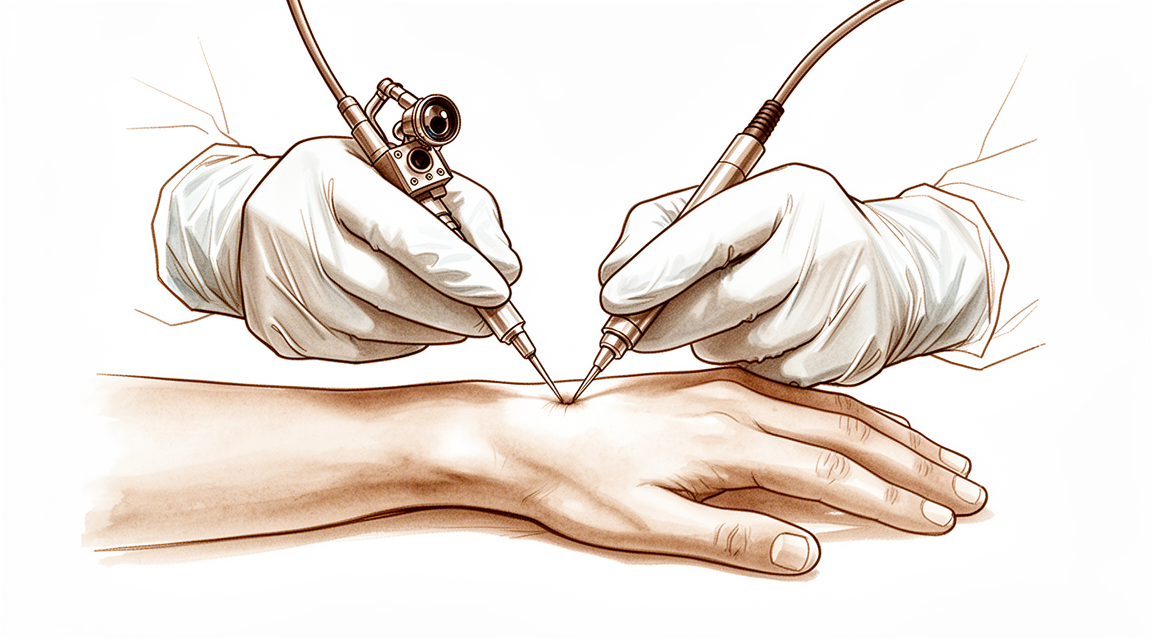
A recovery plan after keyhole (arthroscopic) wrist surgery, where the pace depends on what was done inside: a clean-up (debridement, synovectomy, ganglion or central TFCC tidy-up) allows early movement and a quick return, while a TFCC repair protects forearm rotation in a splint or cast for about four to six weeks before motion and strength are rebuilt.
This protocol guides your recovery after keyhole (arthroscopic) surgery on the wrist with Dr Kieran Hirpara at Mater Private Hospital Rockhampton. Wrist arthroscopy is done through a few tiny incisions (portals) on the back of the wrist, so the skin heals quickly — but the pace of your recovery depends on what was done inside the joint. It begins with your home exercise program, followed by the structured clinical protocol written for your hand therapist — bring this page or its PDF to your first therapy visit so your rehabilitation stays coordinated, and so your therapist follows the plan that matches your operation. Your therapist may adjust the plan depending on how your recovery progresses.
If you have any concerns about your wounds after surgery, get in touch with the rooms. It is often helpful to take a photo of the wound and email it for review.
What to expect
Wrist arthroscopy means the surgeon works inside your wrist through small keyhole portals using a tiny camera and fine instruments. Because the cuts are small, the skin and soft tissues heal fast — but the inside of the wrist sets the timetable, and there are two very different recovery paths:
-
A clean-up (debridement, synovectomy, dorsal ganglion removal, or a central TFCC tidy-up). Here, nothing is stitched back together that needs protecting — damaged or inflamed tissue is simply trimmed or removed. So immobilisation is brief (often just a soft dressing or short splint for comfort), wrist movement begins within days, and you return to most activities over a few weeks. The central part of the TFCC (the cushion on the little-finger side of the wrist) has no blood supply and cannot heal if stitched, so when it is torn there it is trimmed rather than repaired — and that trimming behaves like a clean-up.
-
A TFCC repair (a peripheral or foveal tear stitched back down). The outer rim of the TFCC does have a blood supply and can heal, so when it is torn there it is repaired — and that repair must be protected. The single biggest stress on a healing TFCC repair is turning the forearm (rotating the palm up and down). Because of that, the wrist and forearm are rested in a splint or a Muenster (above-elbow) cast for about four to six weeks — this lets the elbow bend but blocks the forearm rotation that would pull on the repair. Movement, then strength, are then rebuilt in careful stages, and full recovery takes around three months or more.
Throughout both paths, the fingers are kept moving from the start (they were not operated on), swelling is controlled, and the small portal scars are looked after. Your hand therapist will follow the plan for what was actually done in your wrist — if you are unsure which path you are on, ask Dr Hirpara or check your operation note.
Precautions and limitations
- Keep your fingers moving from the start — make a fist and straighten out fully, several times a day. This is always allowed and prevents stiffness and swelling.
- Follow the plan for what was done. After a clean-up, gentle wrist movement starts within days. After a TFCC repair, the wrist and forearm stay protected in a splint or cast and you do NOT turn the forearm (palm up / palm down) until your hand therapist clears it (about four to six weeks).
- After a TFCC repair, do NOT force or load forearm rotation, and do NOT grip or lift heavily until cleared — rotation and load are exactly what stress the repair.
- Keep the keyhole portals clean and dry until healed; do NOT soak or scrub them. Look after the small scars once they have healed.
- Do NOT drive while your wrist is splinted, casted, or unable to safely control the wheel; arrange help with transport in the early weeks.
- Use the hand for light everyday tasks within comfort, as long as it does not involve the movements or loading you have been told to avoid.
For wound, swelling and scar management, see the practice's wound care guidance.
Your exercises
Kieran Hirpara 4.0
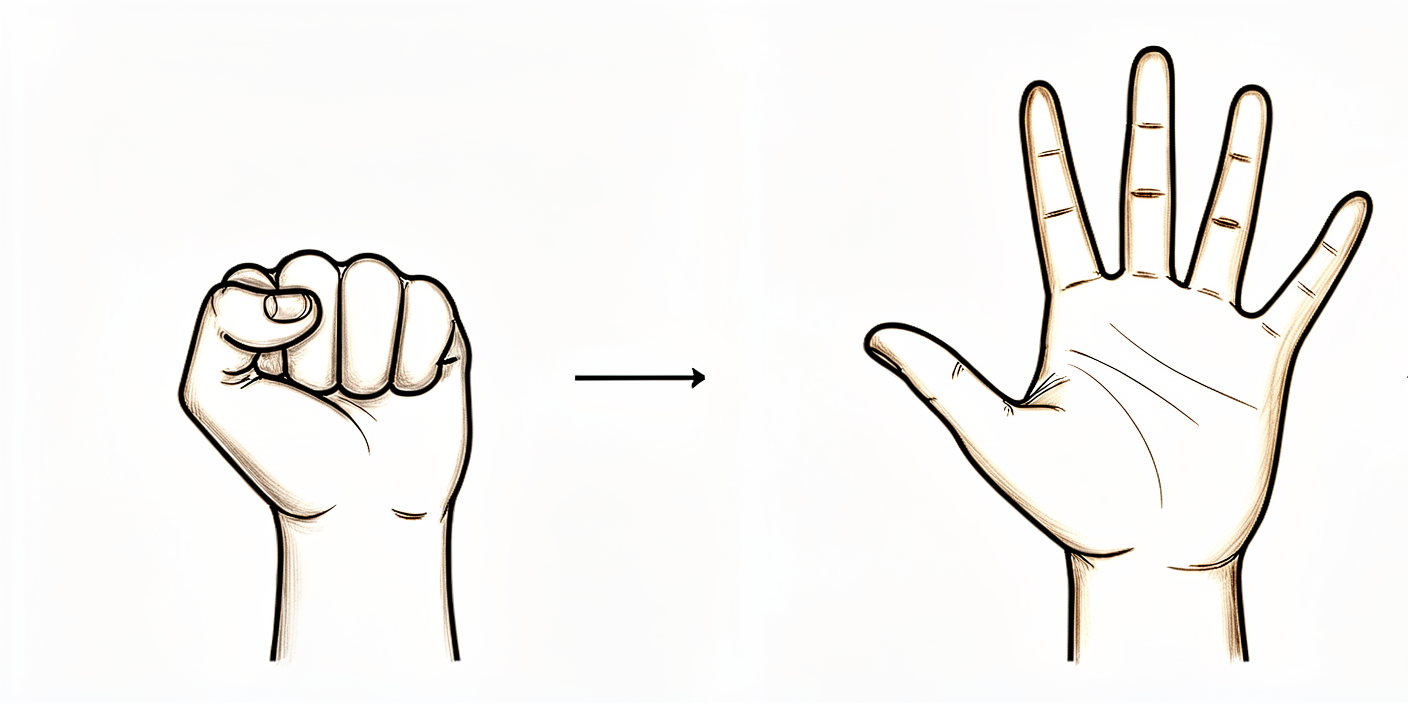
Finger movement (early)
From the first day or two, slowly make a full fist, then straighten your fingers all the way out. The fingers are not part of what was repaired, so keeping them moving is encouraged from the start — it controls swelling and stops the hand stiffening. Do this even while your wrist is resting in a splint or cast.
10 times, several times a day, from the start
Kieran Hirpara 4.0
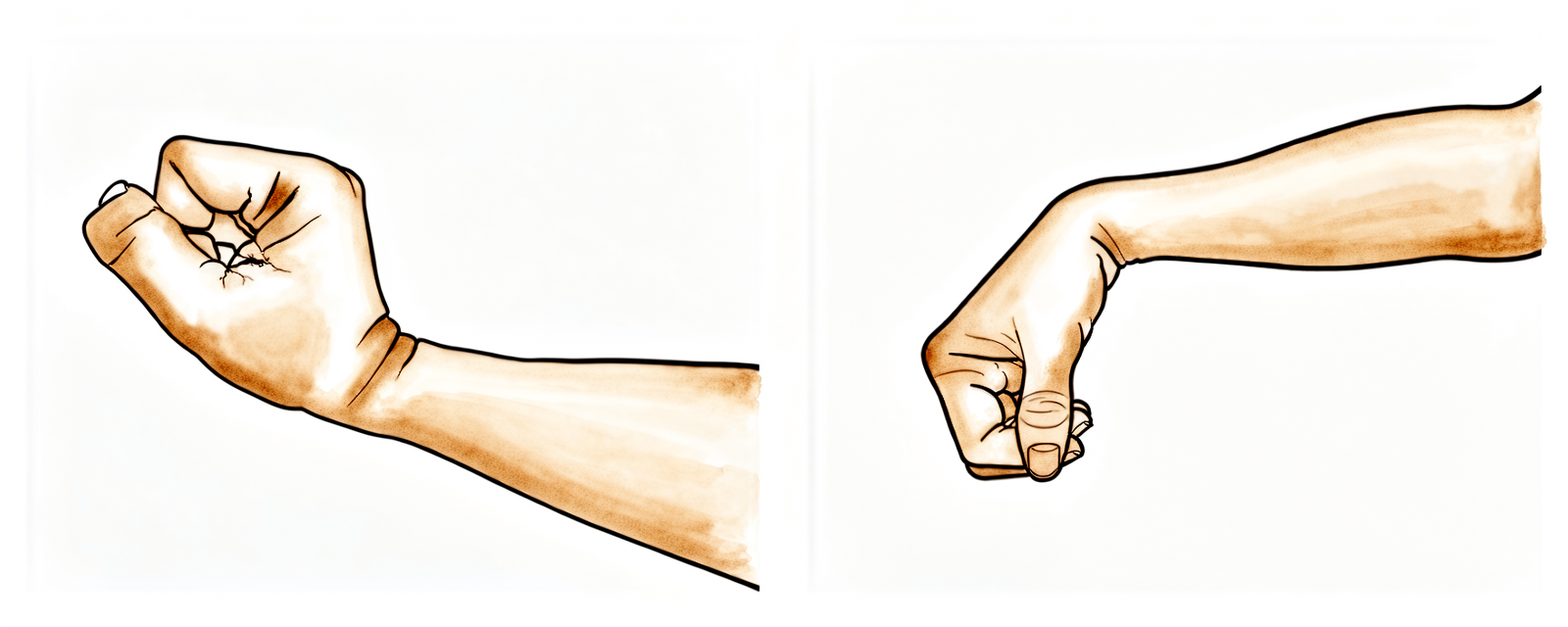
Wrist movement (per your plan)
If you had a clean-up (debridement, synovectomy or ganglion removal), gentle wrist bending up and down — and side to side — usually begins within a few days, as soon as comfort allows. If you had a TFCC repair, the wrist is rested in a splint or cast first, and wrist movement begins later, only when your hand therapist starts it. Always stay within the range you have been given.
10 times each direction, 2–3 times a day, once started
Kieran Hirpara 4.0
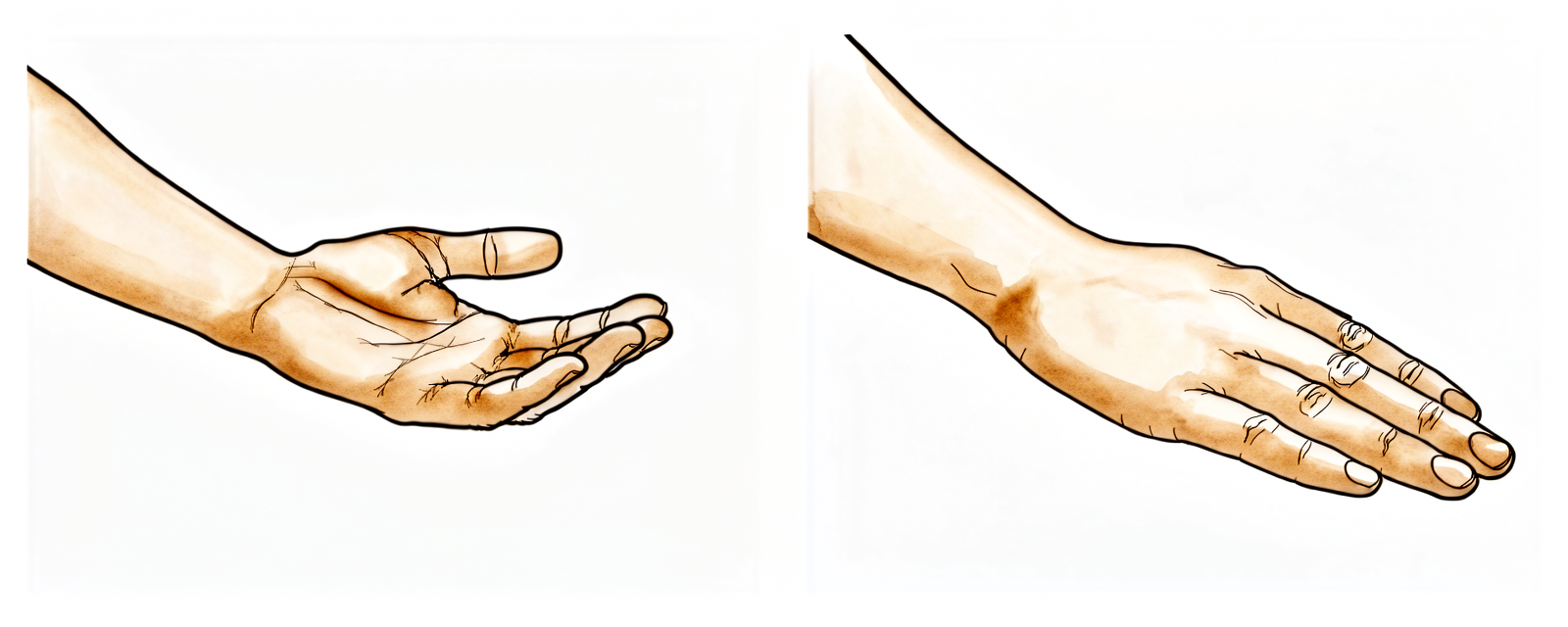
Forearm rotation — palm up / palm down (per your plan)
With your elbow tucked at your side, gently turn your palm up towards the ceiling, then down towards the floor. After a clean-up this can usually begin early. After a TFCC repair this is the LAST motion to be freed — turning the forearm stresses the repair, so it is held back in a splint or cast for about four to six weeks and then re-introduced gradually. Only do this once your hand therapist has cleared it.
10 times each direction, 2–3 times a day, once cleared
Scar and portal care
Once the small portal wounds are fully healed and dry, massage each little scar with a fingertip using a plain moisturiser, in small circles. Keyhole portals are tiny but can feel tight or sensitive — gentle massage and tapping (desensitisation) keep the skin supple and settle any tenderness.
A few minutes, 2–3 times a day, once wounds are healed
Kieran Hirpara 4.0
Grip strengthening (later)
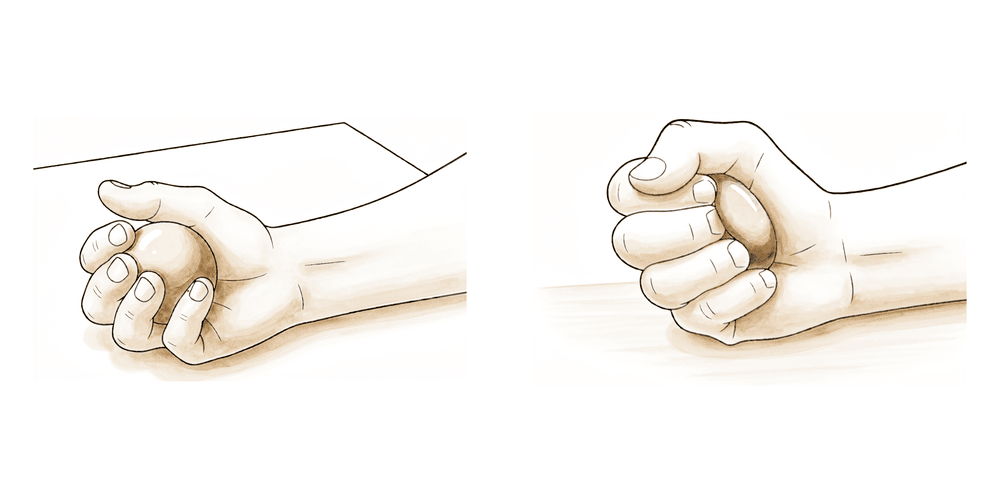
A LATER exercise — only once your hand therapist starts it. Squeeze a soft ball or therapy putty, hold briefly, then relax. After a clean-up, light gripping often begins within a couple of weeks; after a TFCC repair, strengthening waits until about eight weeks, once movement has returned. Build the effort up gradually and stop if it is sharply painful.
10–15 squeezes, 2–3 times a day, when cleared
These are the exercises from your handout. Start them only as guided by Dr Hirpara and your hand therapist, staying within whatever range and limits you have been given. Finger movement and swelling control begin from the start for everyone. Wrist movement, forearm rotation and grip are gated by what was done — early after a clean-up, but held back after a TFCC repair (forearm rotation especially, which is the last thing to be freed). Scar and portal care begins once the small wounds have healed. Stop anything that causes sharp pain.
Your clinical protocol
The rest of this page is the staged clinical protocol for rehabilitation after wrist arthroscopy. This section is to be provided to the hand therapist, and each phase opens with a plain-English explanation of what is happening. The protocol forks on what was done. A diagnostic-or-therapeutic clean-up (debridement, synovectomy, dorsal ganglion excision, chondral or scapholunate debridement, central TFCC debridement) follows the early-motion path. A peripheral/foveal TFCC repair follows the protected-rotation path, because forearm rotation loads the repair. Always confirm with the operation note and the treating surgeon which path applies.
Prior to treatment, check the patient's operation report and past medical history, and liaise with the treating surgeon regarding the procedure performed (pure debridement/synovectomy/ganglion/central-TFCC debridement vs peripheral/foveal TFCC repair), any associated DRUJ instability, and the prescribed immobilisation. The two pathways below differ chiefly in how long forearm rotation is protected.
Path A — Clean-up (debridement / synovectomy / ganglion / central-TFCC debridement): early-motion
The clean-up path removes or trims tissue without creating a construct that needs protecting, so the goal is to restore motion early and avoid stiffness. Immobilisation is brief and for comfort only.
Phase I — early motion (weeks 0 to 2)
The first couple of weeks settle swelling and pain while motion begins almost immediately.
For your hand therapist:
Education and precautions - Immobilisation is soft dressing or a short splint for comfort only, typically up to ~2 weeks; no rotation restriction for a pure central debridement/synovectomy/ganglion - Fingers, thumb and (where comfortable) wrist move from day one - Keep portals clean and dry until healed
Management - Oedema: elevation, gentle finger pumping, ice as needed - Exercises: full active finger and thumb ROM from the start; active wrist flexion/extension and radial/ulnar deviation as comfort allows within the first days; gentle forearm pronation/supination as comfort allows - Wound: portal dressings as directed; monitor for infection
Criteria to progress - Portals healed; swelling settling; comfortable early ROM
Phase II — restoring motion and starting strength (weeks 2 to 6)
Motion is normalised and light strengthening is added once range is comfortable.
For your hand therapist:
Assessments - Active and passive wrist ROM and forearm rotation; grip; pain and swelling; scar/portal review
Management - Exercises: progress to full wrist and forearm ROM; begin light grip and putty strengthening from around 2 weeks; commence scar/portal desensitisation and massage once healed - Progress functional hand use as comfort allows
Criteria to progress - Near-full painless ROM; settled swelling; grip building
Phase III — strengthening and return (weeks 4 to 6 and beyond)
Strength and task tolerance are built back; most patients return to normal activity over a few weeks. Note that a clean-up gives reliable symptom relief but is not guaranteed for diffuse or recalcitrant ulnar-sided pain — manage expectations where pain is non-focal.
For your hand therapist:
Management - Exercises: graded grip and forearm/wrist strengthening; task- and work-specific loading - Return to light/most activity typically 2–6 weeks; heavier manual or sporting load as tolerated and criterion-based - Consider discharge once strength is near-symmetrical and function restored
Path B — Peripheral / foveal TFCC repair: protected rotation
The repair stitches the outer (vascularised) rim of the TFCC back down. Because forearm rotation stresses the repair, the forearm is protected in a splint or Muenster (above-elbow) cast — which allows elbow flexion/extension but blocks pronation/supination — for about four to six weeks. Motion, then strength, are then graded back.
Phase I — protected immobilisation (weeks 0 to 6)
The repair is protected from rotational load while the fingers stay mobile. Practice varies, but the most common pattern is forearm immobilisation in neutral-to-slight-supination for about six weeks; an above-elbow (Muenster) cast or splint is used when rotation must be firmly controlled.
For your hand therapist:
Education and precautions - Immobilise to protect forearm rotation: splint or Muenster/above-elbow cast (elbow free, forearm rotation blocked), forearm in neutral to slight supination, for ~4–6 weeks (commonly 6) - No active or passive forearm pronation/supination during this phase - Full finger and thumb ROM from day one; gentle shoulder ROM - Keep portals clean and dry; monitor for infection
Management - Oedema: elevation, finger pumping, ice as needed - Exercises: finger/thumb AROM; isolated elbow flexion/extension if a Muenster permits; no wrist or forearm rotation loading - Wound/scar: portal care; begin scar work once healed
Criteria to progress - ~4–6 weeks elapsed; repair protected; portals healed; fingers supple
Phase II — graded motion (weeks 6 to 8)
The cast/splint comes off and motion is rebuilt, introducing forearm rotation last and gradually, as it is the motion that stressed the repair.
For your hand therapist:
Assessments - Wrist and forearm ROM; pain and swelling; scar review
Management - Exercises: begin active wrist flexion/extension and radial/ulnar deviation; gradually re-introduce forearm pronation/supination within comfort — build the rotation arc up over the following weeks rather than forcing it - Continue scar/portal desensitisation
Criteria to progress - Comfortable, improving wrist and forearm ROM; pain settling
Phase III — strengthening and return (weeks 8 to 12+ and beyond)
Strengthening begins once roughly 70–100% of wrist and forearm motion is restored, then load and task tolerance are graded back.
For your hand therapist:
Assessments - Grip and forearm strength versus the other side; pain/swelling response to loading; functional and work-/sport-specific testing
Management - Exercises: begin grip and forearm/wrist strengthening from around 8 weeks, once 70–100% of ROM is regained; progress to graded resisted and task-specific loading - Return to sport/heavier work is criterion-based, typically around three months (range ~3–4+ months depending on demand) - Consider discharge once strength is near-symmetrical and function restored; refer back to the treating doctor if recovery plateaus or DRUJ instability recurs
Getting back to work and activity
Light everyday hand use — eating, writing, light self-care — is encouraged from the start within comfort, as long as it stays within the limits you have been given. Driving resumes once you are out of any splint or cast and can safely control the wheel, as confirmed at your review; plan for help with transport in the early weeks.
How quickly you return depends on what was done. After a clean-up (debridement, synovectomy, ganglion or central-TFCC tidy-up), most people are back to normal light activity within two to six weeks, with heavier load built back as comfort allows. After a TFCC repair, forearm rotation is protected for about four to six weeks, strengthening begins from around eight weeks, and return to sport or heavier manual work is usually around three months — judged by regaining movement and adequate, symmetrical strength, not by the calendar alone, and decided by Dr Hirpara and your hand therapist together.
After your protocol
This protocol works alongside the practice's general recovery advice — see managing post-operative pain, wound care and scar management. If your operation involved the distal radioulnar joint or you are unsure which pathway applies, the distal radioulnar joint (DRUJ) hemiresection protocol is a related sibling. The phased plan above reflects published rehabilitation guidance after wrist arthroscopy and TFCC surgery, and your ongoing recovery is guided individually by Dr Hirpara and your hand therapist according to how your wrist progresses.
Evidence & references
Wrist Arthroscopy — Procedure Outcomes & Post-operative Rehabilitation (Diagnostic / Therapeutic Keyhole Wrist Surgery)
Topic scope: post-operative rehabilitation after arthroscopic wrist surgery through small dorsal portals — covering debridement (central TFCC, chondral, scapholunate), synovectomy, dorsal ganglion excision, and peripheral/foveal TFCC repair. The defining feature of this topic is that a single operative approach (keyhole access) covers procedures with opposite rehabilitation needs: a clean-up creates nothing to protect and follows an early-motion pathway, whereas a repair creates a construct loaded by forearm rotation and must be protected. The rehabilitation pathway is therefore gated by what was done, not by the fact that arthroscopy was used.
Defining principle of the rehab here: wrist arthroscopy is a route, not a single operation. Where tissue is only removed (debridement of an avascular central TFCC tear, synovectomy, a dorsal ganglion, a chondral or scapholunate tidy-up), nothing has been reconstructed — immobilisation is brief and for comfort, wrist motion begins within days, and return is measured in weeks. Where the vascularised peripheral or foveal TFCC is repaired, the dominant stress on the construct is forearm rotation (pronation/supination), so the forearm is protected — typically a splint or Muenster (above-elbow) cast that frees the elbow but blocks rotation — for about 4–6 weeks, after which motion and then strength are graded back over roughly three months. The single branch point a therapist must establish from the operation note is debridement-class vs repair-class, and within repair, how long rotation is to be protected. The rehabilitation evidence itself is low-level and heterogeneous — protocols rest on biology, surgeon preference and expert/therapist consensus more than on trials.
A. PROCEDURE OUTCOMES (debridement / synovectomy / ganglion vs TFCC repair)
Wrist arthroscopy is both the diagnostic gold standard and the therapeutic workhorse for intra-articular ulnar-sided wrist pathology. The principal outcome split is between clean-up procedures and repair.
- Wrist arthroscopy is a versatile, low-morbidity platform. Through small dorsal portals it permits direct inspection and treatment of TFCC tears, chondral lesions, synovitis and ganglia, with the keyhole approach giving fast soft-tissue healing and small scars [Gupta, Bozentka, Osterman — JAAOS 2001, DOI 10.5435/00124635-200105000-00006]. Narrative/mechanistic.
- Arthroscopic debridement of central (Palmer 1A) TFCC tears relieves symptoms in well-selected, focal cases. The central disc is avascular and cannot heal if sutured, so trimming is the rational treatment; classic and long-term series report good symptom relief and durable function in suitable patients [Osterman — Arthroscopy 1990, DOI 10.1016/0749-8063(90)90012-3; Soreide et al., 19-year follow-up — HAND 2017, DOI 10.1177/1558944717708029]. Moderate–weak (case series, long follow-up).
- Debridement is unreliable for diffuse, non-focal ulnar-sided wrist pain. Where pain is recalcitrant and not clearly localised to a focal central tear, simple arthroscopic debridement has little useful value on the clinical course — a caution against over-attributing diffuse ulnar wrist pain to a debridable lesion [Nishizuka et al. — Bone Joint J 2013, DOI 10.1302/0301-620x.95b12.31918]. Moderate (prospective cohort).
- Peripheral/foveal TFCC repair restores DRUJ stability and gives good outcomes when the rim is repairable. All-arthroscopic and arthroscopic-assisted repair techniques (e.g. FasT-Fix, all-inside suture) report reliable pain relief, return of grip and high return-to-activity rates in vascularised peripheral tears, especially with DRUJ instability [Yao, Dantuluri, Osterman — Arthroscopy 2007, DOI 10.1016/j.arthro.2007.02.010; Yao — Hand Clin 2011, DOI 10.1016/j.hcl.2011.05.004]. Moderate–weak (technique series).
- Procedure choice is driven by tear location and DRUJ stability. Central tears → debridement; peripheral/foveal tears, particularly with DRUJ instability → repair. In ulnar-positive wrists, peripheral repair may be combined with or weighed against ulnar shortening osteotomy [Papapetropoulos et al. — J Hand Surg Am 2010, DOI 10.1016/j.jhsa.2010.06.015]. Moderate.
- Arthroscopic dorsal ganglion excision gives recurrence rates comparable to (or, in some series, better than) open excision, with the keyhole advantage of faster recovery and smaller scars. Arthroscopic resection reliably removes the cyst and addresses the stalk at its capsular origin [Nishikawa et al. — J Hand Surg Br 2001, DOI 10.1054/jhsb.2001.0620; Luchetti et al. — J Hand Surg Br 2000, DOI 10.1054/jhsb.1999.0290; Konigsberg et al. — HAND 2021, DOI 10.1177/15589447211003184; Suen, Fung, Lung — ISRN Orthop 2013, DOI 10.1155/2013/940615]. Moderate–weak (retrospective comparison + series).
B. REHABILITATION / THERAPY EVIDENCE
The central rehab question is how long, and against what, to protect the wrist — and the answer is set entirely by the procedure. The evidence base for the rehabilitation (as opposed to the surgery) is low-level and markedly heterogeneous, with no level-1 protocol and wide variation in immobilisation and progression timings; recommendations are best regarded as biologically-rationalised, consensus-driven guides rather than trial-proven schedules.
- Clean-up procedures follow an early-motion pathway. After debridement, synovectomy or ganglion excision there is no construct to protect: immobilisation is a soft dressing or short splint for comfort (≈2 weeks at most), wrist motion begins within days, and light grip strengthening is added at around 2 weeks. Return to most activity is measured in weeks (≈2–6) [How-we-treat reviews and technique series; consistent across sources]. Weak–moderate (consensus + series).
- TFCC repair protects forearm rotation, not just the wrist. Because pronation/supination is the dominant load on a peripheral/foveal repair, the forearm is immobilised — commonly a splint or Muenster/above-elbow cast that frees the elbow but blocks rotation — for about 4–6 weeks (six is the most commonly reported figure), in neutral to slight supination [scoping review of arthroscopic peripheral TFCC repair rehabilitation, PMC12274733; Australian hand-therapist survey of foveal-repair rehabilitation, J Hand Ther 2024]. Weak–moderate (scoping review + survey of practice).
- Forearm rotation is re-introduced last and graded. After the protected phase, wrist flexion/extension and deviation are restored first, with pronation/supination re-introduced gradually because it is the motion that stressed the repair. Strengthening typically begins once 70–100% of wrist and forearm ROM is regained (around 8 weeks) [scoping review PMC12274733]. Weak (consensus from heterogeneous protocols).
- Rehabilitation protocols are heterogeneous and lack consensus. Across studies, complete immobilisation ranged 1–8 weeks (forearm most commonly 6), ROM commencement and strengthening start varied widely (strengthening 3–12 weeks), and authors explicitly call for level-1 evidence. The practical implication is to follow the operating surgeon's prescription for the specific repair rather than a fixed universal schedule [scoping review PMC12274733; Australian hand-therapist survey]. Weak (the evidence's own conclusion).
Recovery trajectory (expected, evidence-anchored)
| Phase | Window | Restraint | Hand use / therapy focus | Strength / load | Notes |
|---|---|---|---|---|---|
| Clean-up I — early motion | Week 0–2 | Soft dressing / short splint for comfort | Fingers move day 1; early wrist flexion/extension, deviation and gentle forearm rotation within days; portal care | Light functional use | No construct to protect; rotation not restricted for central debridement/synovectomy/ganglion |
| Clean-up II–III — restore & return | Week 2–6+ | Restrictions lifted | Full wrist/forearm ROM; scar/portal desensitisation once healed | Light grip/putty from ~2 wk, graded loading thereafter | Return to most activity 2–6 wk; debridement unreliable for diffuse (non-focal) ulnar pain |
| Repair I — protected immobilisation | Week 0–6 | Forearm rotation blocked (splint / Muenster cast, neutral–slight supination) | Full finger/thumb ROM day 1; elbow flexion/extension if Muenster permits; no pronation/supination | None to the repair | ~4–6 wk (commonly 6); rotation is the dominant repair load |
| Repair II — graded motion | Week 6–8 | Rotation re-introduced gradually | Active wrist flexion/extension & deviation; forearm rotation re-introduced last and built up | Light, no resisted load yet | Restore motion before strength |
| Repair III — strengthen & return | Week 8–12+ | Load progressed by criteria | Grip/forearm strengthening once 70–100% ROM regained; task-specific loading | Strengthening from ~8 wk; graded resisted load | Return to sport/heavy work ~3 months (range ~3–4+); grip ~85% of opposite side, ~87% return to pre-injury activity |
(Phase windows mirror the precautions and recovery structure in the patient protocol; they are typical, consensus-derived guides — not trial-derived deadlines, and the surgeon's prescription overrides them.)
C. KEY CONTROVERSIES / EVIDENCE QUALITY
- Debridement vs repair is decided by tear location and DRUJ stability, not access. Central (avascular) tears are trimmed; peripheral/foveal (vascularised) tears, especially with DRUJ instability, are repaired. The same keyhole approach therefore launches opposite rehab pathways — the therapist must establish which from the operation note. Strong biological rationale, moderate clinical evidence.
- Debridement is not a panacea for ulnar wrist pain. It relieves focal central-tear symptoms but has little value for diffuse, recalcitrant ulnar-sided pain — a key expectation-setting point [Nishizuka 2013]. Moderate.
- How long to protect forearm rotation after repair is unsettled. Reported immobilisation ranges 1–8 weeks (forearm most commonly 6); there is no level-1 consensus, and practice (including Australian hand-therapist practice) varies. The defensible position is to protect rotation ~4–6 weeks and follow the operating surgeon. Weak (heterogeneous).
- Arthroscopic vs open ganglion excision. Recurrence is broadly comparable, with arthroscopy offering faster recovery and smaller scars; the evidence is retrospective rather than randomised [Konigsberg 2021; Nishikawa 2001; Luchetti 2000]. Moderate–weak.
- The rehabilitation evidence base is the weak link, not the surgery. Outcome studies of the operations outnumber and outrank the rehabilitation studies; rehab timings are biologically and consensus-driven, and the literature itself calls for level-1 trials [scoping review PMC12274733]. Weak.
D. EVIDENCE STRENGTH FLAGS (summary)
- MODERATE: versatility and low morbidity of wrist arthroscopy as a diagnostic/therapeutic platform; symptom relief from debridement of focal central TFCC tears (with long-term series); limited value of debridement for diffuse ulnar wrist pain; comparable recurrence of arthroscopic vs open dorsal ganglion excision; good outcomes of peripheral/foveal TFCC repair when the rim is repairable.
- WEAK / CONSENSUS: the specific rehabilitation schedules — clean-up early-motion (~2-wk comfort splint, motion within days, return 2–6 wk) and repair protected-rotation (splint/Muenster ~4–6 wk, ROM then strength from ~8 wk, return ~3 months). Immobilisation duration and progression timings are heterogeneous across the literature with no level-1 consensus; figures are typical guides, and the operating surgeon's prescription governs.
- EXPECTATION-SETTING (natural history): grip recovers to ≈85% of the opposite side and ≈87% of patients return to pre-injury activity after TFCC repair; debridement of diffuse (non-focal) ulnar wrist pain may not relieve symptoms.
CITATIONS
RAG corpus (180,000+ Orthopaedic articles)
- Wrist arthroscopy: principles and clinical applications. J Am Acad Orthop Surg. 2001. DOI: 10.5435/00124635-200105000-00006
- Arthroscopic debridement of triangular fibrocartilage complex tears. Arthroscopy. 1990. DOI: 10.1016/0749-8063(90)90012-3
- Arthroscopic-assisted resection of triangular fibrocartilage complex lesions: a 19-year follow-up. HAND. 2017. DOI: 10.1177/1558944717708029
- Simple debridement has little useful value on the clinical course of recalcitrant ulnar wrist pain. Bone Joint J. 2013. DOI: 10.1302/0301-620x.95b12.31918
- A novel technique of all-inside arthroscopic triangular fibrocartilage complex repair. Arthroscopy. 2007. DOI: 10.1016/j.arthro.2007.02.010
- All-arthroscopic repair of peripheral triangular fibrocartilage complex tears using FasT-Fix. Hand Clin. 2011. DOI: 10.1016/j.hcl.2011.05.004
- Management of peripheral triangular fibrocartilage complex tears in the ulnar positive patient: arthroscopic repair versus ulnar shortening osteotomy. J Hand Surg Am. 2010. DOI: 10.1016/j.jhsa.2010.06.015
- Arthroscopic diagnosis and treatment of dorsal wrist ganglion. J Hand Surg Br. 2001. DOI: 10.1054/jhsb.2001.0620
- Arthroscopic resection of dorsal wrist ganglia and treatment of recurrences. J Hand Surg Br. 2000. DOI: 10.1054/jhsb.1999.0290
- Recurrence rates of dorsal wrist ganglion cysts after arthroscopic versus open surgical excision: a retrospective comparison. HAND. 2021. DOI: 10.1177/15589447211003184
- Treatment of ganglion cysts. ISRN Orthop. 2013. DOI: 10.1155/2013/940615
Wrist arthroscopy / TFCC rehabilitation literature (URLs)
- Clinical and functional outcomes of rehabilitation strategies following arthroscopic repair of chronic isolated peripheral TFCC tears: a scoping review. J Orthop. 2025. PMC. https://pmc.ncbi.nlm.nih.gov/articles/PMC12274733/
- Current rehabilitation recommendations following primary triangular fibrocartilage complex foveal repair surgery: a survey of Australian hand therapists. J Hand Ther. 2024. https://www.jhandtherapy.org/article/S0894-1130(23)00117-5/fulltext
- TFCC injuries: how we treat? J Clin Orthop Trauma / PMC. 2020. https://pmc.ncbi.nlm.nih.gov/articles/PMC7384326/
- Review and update on the management of triangular fibrocartilage complex injuries in professional athletes. World J Orthop. 2024. https://www.wjgnet.com/2218-5836/full/v15/i2/110.htm
- Arthroscopic-assisted repair of the triangular fibrocartilage complex. J Hand Surg Glob Online. 2024. https://www.jhsgo.org/article/S2589-5141(24)00066-5/fulltext